

A shopper is on your product page at 11pm asking whether the medium runs small. If nobody answers, they close the tab. If someone answers, two things decide whether that chat was worth having: did the reply use your store data (stock, orders, cart), and did anything happen after the chat ended? Most roundups of the top chat apps on Shopify stop at the widget. This one also looks at what each app does with the conversation afterwards, because a sizing question from a shopper who never checks out is one of the clearest buying signals your store will ever get.
This list is for Shopify merchants choosing their first chat app or replacing one that has become expensive. It covers eight apps, ranked on the same criteria, with prices checked on each vendor’s pricing page or Shopify App Store listing on 1 October 2026. If you sell on more than one platform, our wider guide to the best live chat software for ecommerce covers tools beyond Shopify.
The 8 top chat apps on Shopify, ranked
- Emailwish: best for chat that triggers email follow-ups
- Shopify Inbox: best free starting point
- Tidio: best for an AI agent that can act on orders
- Chatty: best low-cost AI sales chat
- Gorgias: best full helpdesk for support teams
- Chatra: best for small teams that want a human-first chat
- tawk.to: best for free unlimited agents
- Zendesk: best for multi-brand service teams already on Zendesk
Shopify chat apps compared
| App | Best for | Free plan | Paid plans from | SMS | Targeting beyond email and orders | AI answers | Shopify App Store rating |
|---|---|---|---|---|---|---|---|
 Emailwish Emailwish |
Chat that triggers email follow-ups | Yes100 contacts, 1,000 emails/mo, live chat included | $35/mo(Launch) | No | Yeschat, review, popup and wishlist activity on one profile | YesAI answers and order tracking, every plan | (7) |
 Shopify Inbox Shopify Inbox |
Free start, native to Shopify | YesFree app | Free | Not listed | No | YesAI sales associate | (5,791) |
 Tidio Tidio |
AI agent that acts on orders | Yes50 billable conversations | $24.17/mobilled yearly (Starter) | Not listed | No | YesLyro (first 50 conversations free | (1,347) |
 Chatty Chatty |
Low-cost AI sales chat | Yes50 AI conversations/mo | $19.99/mo(Basic) | Not listed | No | Yeson every plan | (1,870) |
 Gorgias Gorgias |
Full ecommerce helpdesk | Nofree trial | $10/mo(Starter, 50 tickets) | Paid add-on | No | Paid AI Agent add-on | (706) |
 Chatra Chatra |
Human-first chat for small teams | Yesup to 5 conversations/mo | $31/agent/mo(Essential) | Not listed | No | Chatbots on paid plans | (305) |
 tawk.to tawk.to |
Free unlimited agents | Yesfree app | $29/moto remove branding | Not listed | No | AI Assist from $29/mo | (89) |
 Zendesk Zendesk |
Large multi-channel service teams | No14-day trial | $55/agent/mobilled yearly (Suite Team, includes live chat) | Not listed | No | YesAI agents from Suite Team | (93) |
Prices are the starting monthly price shown on each vendor’s pricing page or Shopify App Store listing on 1 October 2026, in US dollars. “Not listed” means the feature wasn’t on the pricing page or App Store listing we checked, not that it can’t be bought. Ratings are from the Shopify App Store on the same date.
What to look for in a Shopify chat app
A chat widget on a Shopify store is not the same job as a chat widget on a SaaS website. Your visitors ask about products, sizes, stock and shipping, and the answers live in Shopify. These are the things that separate a useful Shopify chat app from a generic one.
Store data inside the conversation. When a shopper asks “where’s my order?”, the person (or bot) replying should see the order without opening the Shopify admin in another tab. Check whether the app shows the customer’s orders and current cart next to the chat, and whether you can send a product card or discount from the inbox.
How the price is counted. This is the biggest hidden difference between the apps on this list. There are four models:
| Pricing model | Who uses it | What makes the bill go up |
|---|---|---|
| Per agent (seat) | Chatra, Zendesk | Adding team members |
| Per ticket or conversation | Gorgias, Tidio | Busy seasons, sales and launches |
| Per AI conversation | Chatty, Tidio’s Lyro | Letting the bot answer more chats |
| Per email sent | Emailwish | Email volume (chat is included on every plan) |
| Free with paid add-ons | Shopify Inbox, tawk.to | Removing branding, AI or hired agents |
A per-ticket plan looks cheap in March and expensive in November. A per-seat plan punishes you for adding a part-time helper during the holidays. Work out your busiest month before you compare prices.
AI that knows its limits. Most apps now sell an AI agent. The useful question isn’t “does it have AI?” but “what is it allowed to do, and what does each answer cost?” Some only answer FAQs, some recommend products, and a few can edit or cancel orders. Check how usage is capped so a busy weekend doesn’t produce a surprise bill. If AI is the main reason you’re shopping, our list of the best AI chatbots for Shopify goes deeper.
What happens after the chat. This is where most chat apps stop. A shopper asks about a jacket, gets a good answer, and leaves without buying. In a standalone chat app, that conversation sits in an inbox and nobody follows up. Ask whether the app can trigger an email after a chat, or pass that signal to your email tool, and how reliably.
Theme and checkout fit. A chat bubble that covers the “Add to cart” button on mobile costs more sales than it wins. Check that you can change the widget’s position, colour and greeting, and test it on your theme’s product page on a phone before you go live. Our guide on how to add live chat to Shopify walks through the setup.
Channels you actually use. If most of your questions arrive by Instagram DM or WhatsApp, an app that pulls those into one inbox saves real time. If they don’t, you’re paying for a feature you’ll never open.
How we chose the top chat apps on Shopify
We scored every app against the same criteria, in this order of weight. Our editorial policy explains how we test and update roundups.
- Shopify data in the chat. Can the agent see orders, cart and products while replying, and act on them?
- Real cost as you grow. Price at a quiet month and a busy month, and what the pricing model (seats, tickets, AI conversations, emails) does to the bill.
- Free plan or trial. What the free plan really includes, and how quickly you outgrow it.
- Follow-up after the chat. Can a chat trigger an email, or feed segmentation, without a second app?
- AI answers. What the AI can do, what it costs per conversation, and how usage is capped.
- Setup time. How long from install to a working widget on your storefront.
- Built-in features versus integrations. Every extra app is another subscription, another setup, and another place where customer data falls out of sync. Utilizing Shopify product metafields organizes custom data directly within store catalogs. Native tools also allow deeper targeting, because a chat, a review and a popup answer land on the same customer profile.
- Channels. Email, Instagram, Facebook, WhatsApp, SMS and voice, and which plans include them.
- Team features. Assignment, roles, saved replies, operating hours and reporting.
- Support from the vendor. How you reach them, and on which plans.
- Shopify App Store rating (lower weight). A useful signal, but ratings favour apps with large install bases, so we weighed them less than hands-on criteria.
1. Emailwish
Best for chat that triggers email follow-ups
Emailwish is an all-in-one marketing app for Shopify and WooCommerce. Emailwish live chat is one module of it, alongside email marketing and automation, popups and forms, product reviews and wishlists. That’s the reason it’s on this list: the chat doesn’t live in a separate inbox that your email tool never sees.
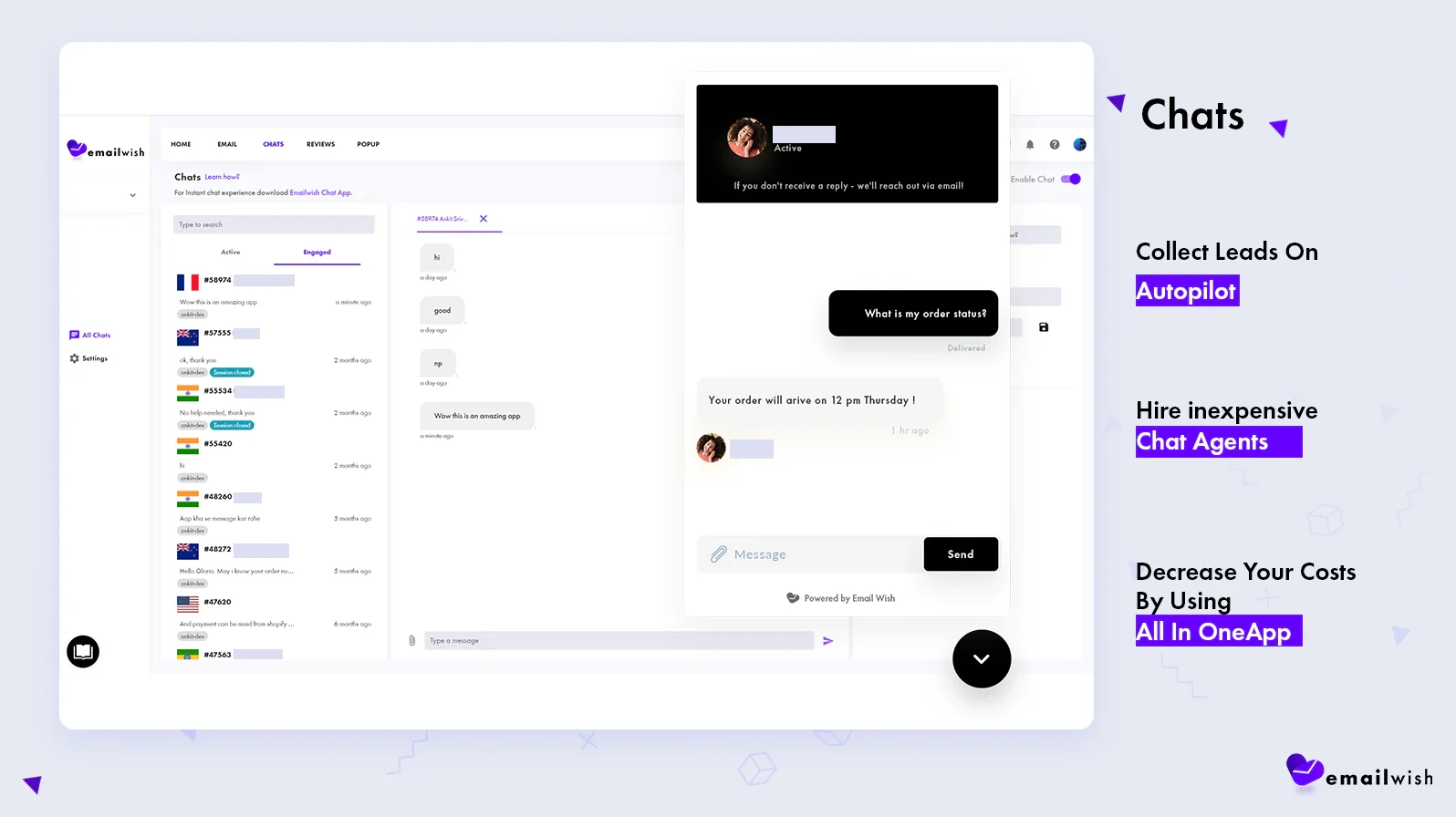
What the chat does. You add a chat widget to your storefront and set its greeting, colour and position to match your theme. Conversations land in one shared team inbox built around products and orders. While you chat, you can see the customer’s Shopify details, including their cart, orders and the products they’re looking at, and you can recommend a product inside the conversation. Emailwish AI answers common questions about orders, shipping and products instantly, 24/7, using your store’s data, and hands the conversation to your team in the same inbox when a person should take over. Shoppers can ask “where’s my order?” and get order status and delivery tracking right in the chat. Team roles control who can manage conversations, and notifications reach you by browser push or email so a shopper isn’t left waiting.
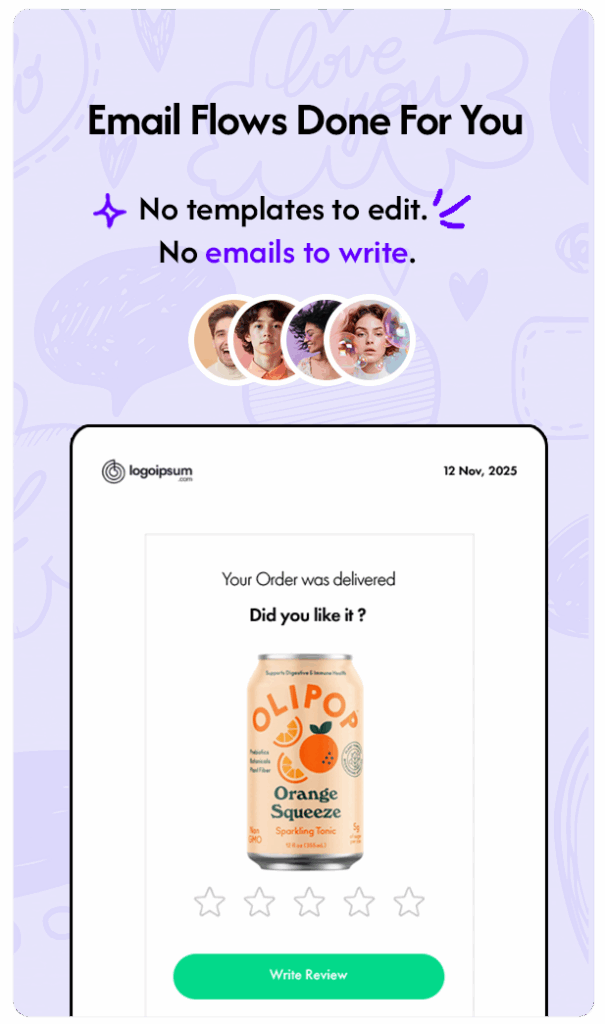
What happens after the chat. This is the part standalone chat apps can’t match. A chat follow-up series is one of about 10 email flows that go live when you set Emailwish up, alongside welcome, abandoned cart, review request, after-review and form signup. Because chat, reviews, popups, wishlists and email share one customer profile, you can target behaviour an email-only tool never sees. For example:
- A shopper asked about sizing in chat but didn’t buy. They get a follow-up email with the product and your size guide.
- A customer who chatted about a delayed order later leaves a 2-star review. You can segment them for a personal apology rather than the next promo email.
- A visitor who wishlisted a product asks in chat when it’s back. Back-in-stock emails go to the shoppers who saved that item.
How setup works. When you install Emailwish, it pulls your store name, logo, social links, products and brand details from Shopify, writes the email copy in your brand’s voice and generates the email images. Shopify orders, products, browsing and checkout events sync in real time, and revenue reporting covers every flow and campaign.
What we liked
- Live chat is included on every plan, including the free Seed plan, with no per-seat or per-ticket charge
- Chats can trigger and target emails because chat and email share one customer profile
- AI answers and order tracking in chat are included on every plan, with the customer’s cart and orders next to the conversation
Where it could improve
- A younger app with fewer integrations than the long-established chat tools, and only 7 App Store reviews so far (4.1)
- No SMS
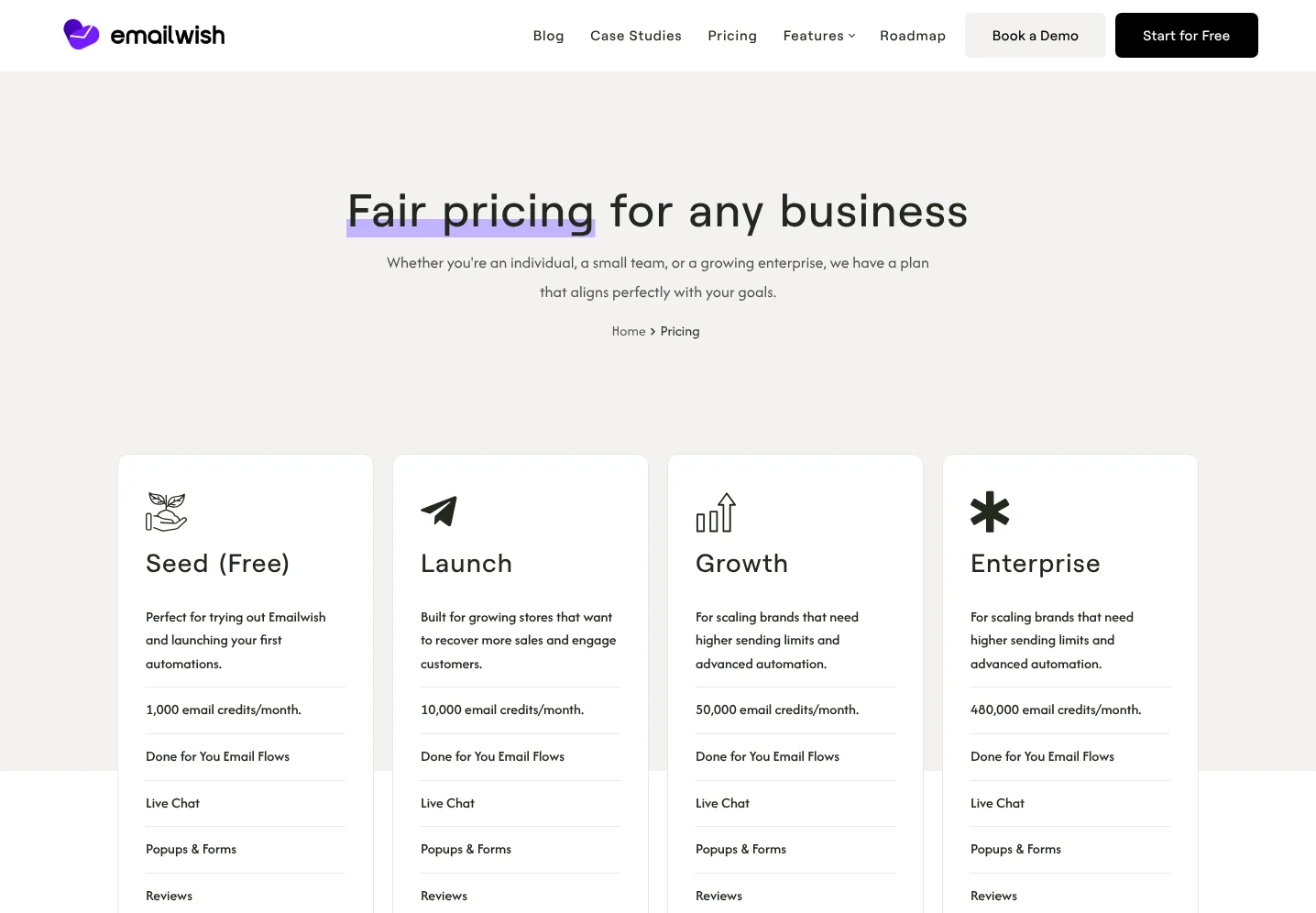
Pricing: Emailwish charges by email credits per month, not by chat agents or conversations. Seed is free (100 contacts, 1,000 emails a month), Launch is $35/month (5,000 contacts, 10,000 emails), Growth is $100/month (50,000 emails) and Enterprise is $1,000/month (480,000 emails). Every plan includes live chat, popups and forms, reviews, automations and segmentation. There’s no trial of paid plans because there’s a free plan, and no contract. See the Emailwish pricing page for the full table.
Support: live chat and email support on every plan, including Free.
Who it’s for: small and growing stores that want chat, email, reviews and popups in one app, and want every chat to count as a marketing signal. AI answers cover common questions around the clock, and your team picks up everything else in the same inbox.
2. Shopify Inbox
Best for a free start that’s native to Shopify
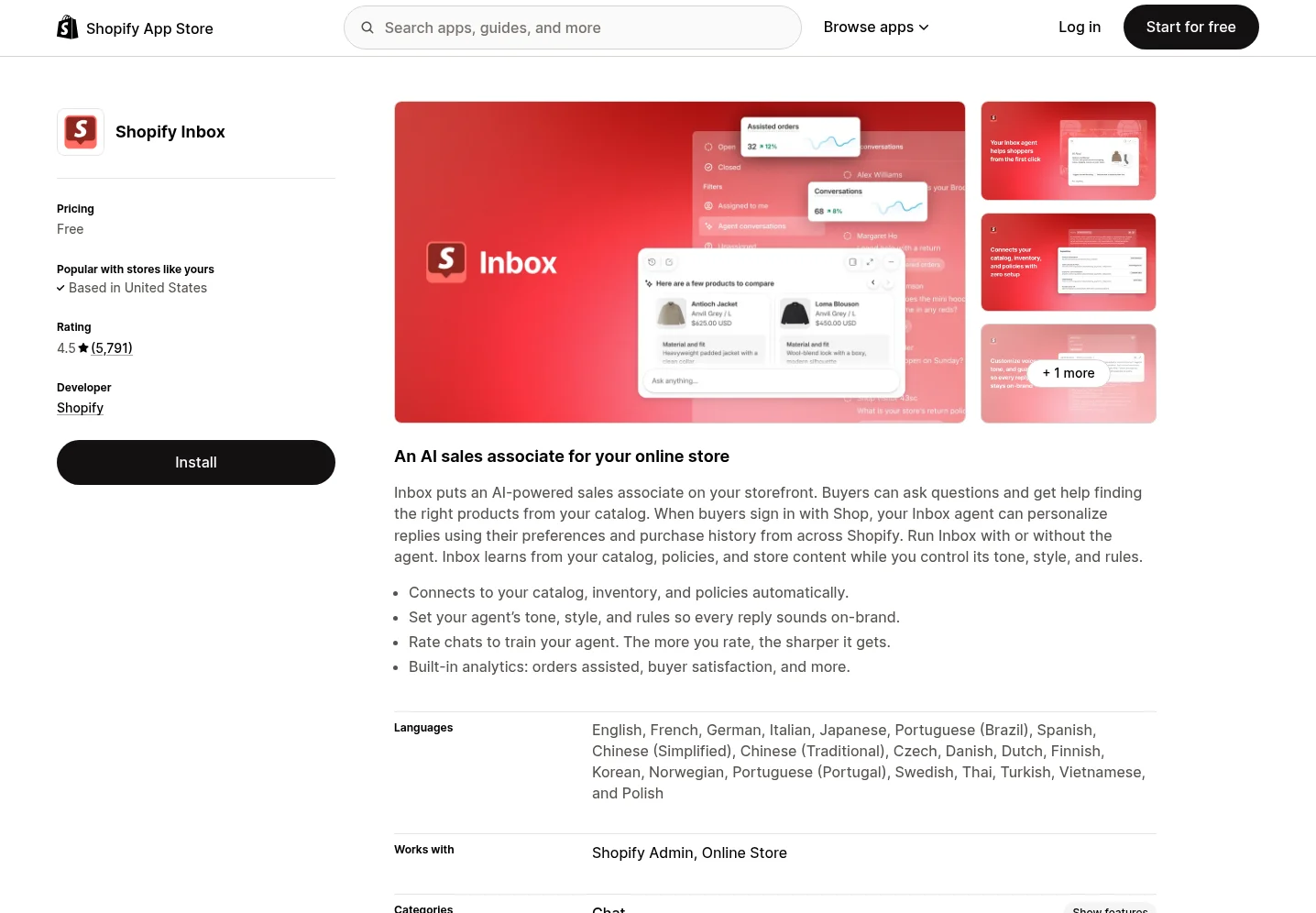
Shopify Inbox is Shopify’s own chat app, and it has changed a lot. Its App Store listing now describes it as an AI sales associate for your storefront: shoppers ask questions and get help finding products from your catalog. The agent learns from your catalog, inventory, policies and store content, and you set its tone, style and rules. When a shopper is signed in with Shop, the agent can personalise replies using their preferences and purchase history from across Shopify. You can also run Inbox without the agent and answer chats yourself.
What changed since our last version. The old version of this article listed a separate Facebook Messenger app for Shopify. That app no longer has a Shopify App Store listing, so Shopify Inbox takes its place here.
What we liked
- Free, made by Shopify, and connects to your catalog, inventory and policies automatically
- The AI agent can be trained by rating its chats, and you control its rules and tone
- Built-in analytics show orders assisted and buyer satisfaction
Where it could improve
- Chats don’t feed a wider customer profile for email, reviews or popups unless you add other apps
- Limited control over pricing, plans and roadmap: you get what Shopify ships
Pricing: free on the Shopify App Store.
Who it’s for: new stores and any store that wants AI product answers at no cost. If you outgrow it, our list of Shopify Inbox alternatives covers the next step.
3. Tidio
Best for an AI agent that can act on orders
Tidio combines live chat, a ticketing inbox and Lyro, its AI agent. According to its App Store listing, Lyro doesn’t only answer questions: within rules you set, it can check order status and handle refunds, cancellations and order edits in Shopify. On product pages it can start conversations, compare products and add items to the cart. When a person takes over, your team sees the shopper’s orders and live cart and can send products, discounts or order updates from the inbox. Chat, email, Instagram and WhatsApp land in one inbox.
What we liked
- Lyro can take actions on Shopify orders, not just reply with FAQ text
- AI usage is capped, so Lyro pauses at your limit instead of running up the bill
- A free plan to test with, plus 50 free Lyro conversations (a one-off allowance)
Where it could improve
- Two meters to watch: billable conversations for the helpdesk and Lyro conversations for the AI
- Chats stay in Tidio; follow-up emails need a connected email tool such as Klaviyo or Mailchimp
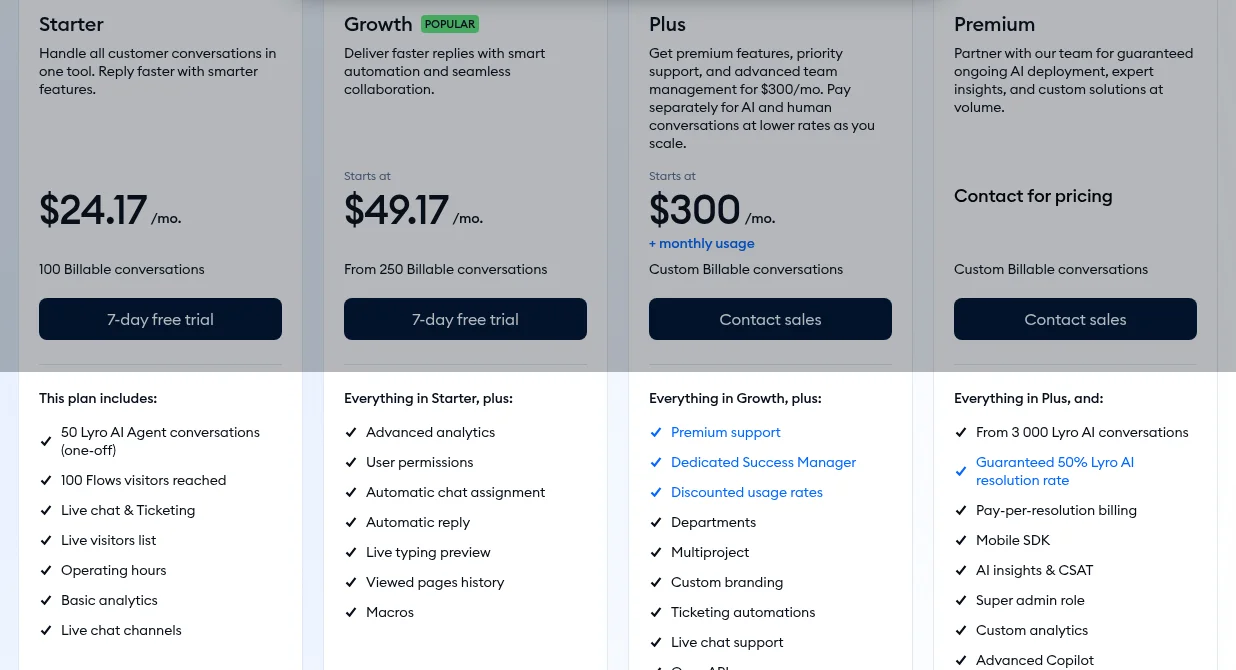
Pricing: the Free plan includes 50 billable conversations and flows that reach 100 visitors. Starter is $24.17/month billed yearly (100 billable conversations), Growth starts at $49.17/month billed yearly (from 250 conversations), Plus starts at $300/month plus usage, and Premium is custom. The App Store listing shows the monthly price of the entry plan as $29/month. Paid plans have a 7-day free trial. Prices from Tidio’s pricing page.
Integrations: the App Store listing names Google Analytics, Judge.me, Klaviyo, Mailchimp, Zapier and Zendesk.
Who it’s for: stores with a steady flow of “where’s my order?” and returns questions that want an AI to resolve them, not just deflect them. Our guide to reducing WISMO tickets explains why that’s often the biggest support cost.
4. Chatty
Best for low-cost AI sales chat
Chatty is a Shopify app that sells itself as an AI sales agent. The AI answers product questions, recommends products and helps with order tracking, and your team works from one inbox that pulls in WhatsApp, Facebook Messenger, Instagram and email. You can also build an FAQ help centre for self-service. Pricing is per store, and what changes between plans is mainly the number of AI conversations and how many products the AI is trained on.
What we liked
- A free plan with 50 AI conversations a month and unlimited human conversations
- The highest App Store rating on this list: 4.9 from 1,870 reviews
- Pro adds proactive messages and abandoned-cart recovery from the chat
Where it could improve
- The AI is trained on a capped number of products per plan (200 on Free, 500 on Basic), so large catalogs need Pro or higher
- Extra AI conversations cost $0.40 each beyond your plan, so a viral week can raise the bill (you can cap spending in the app)
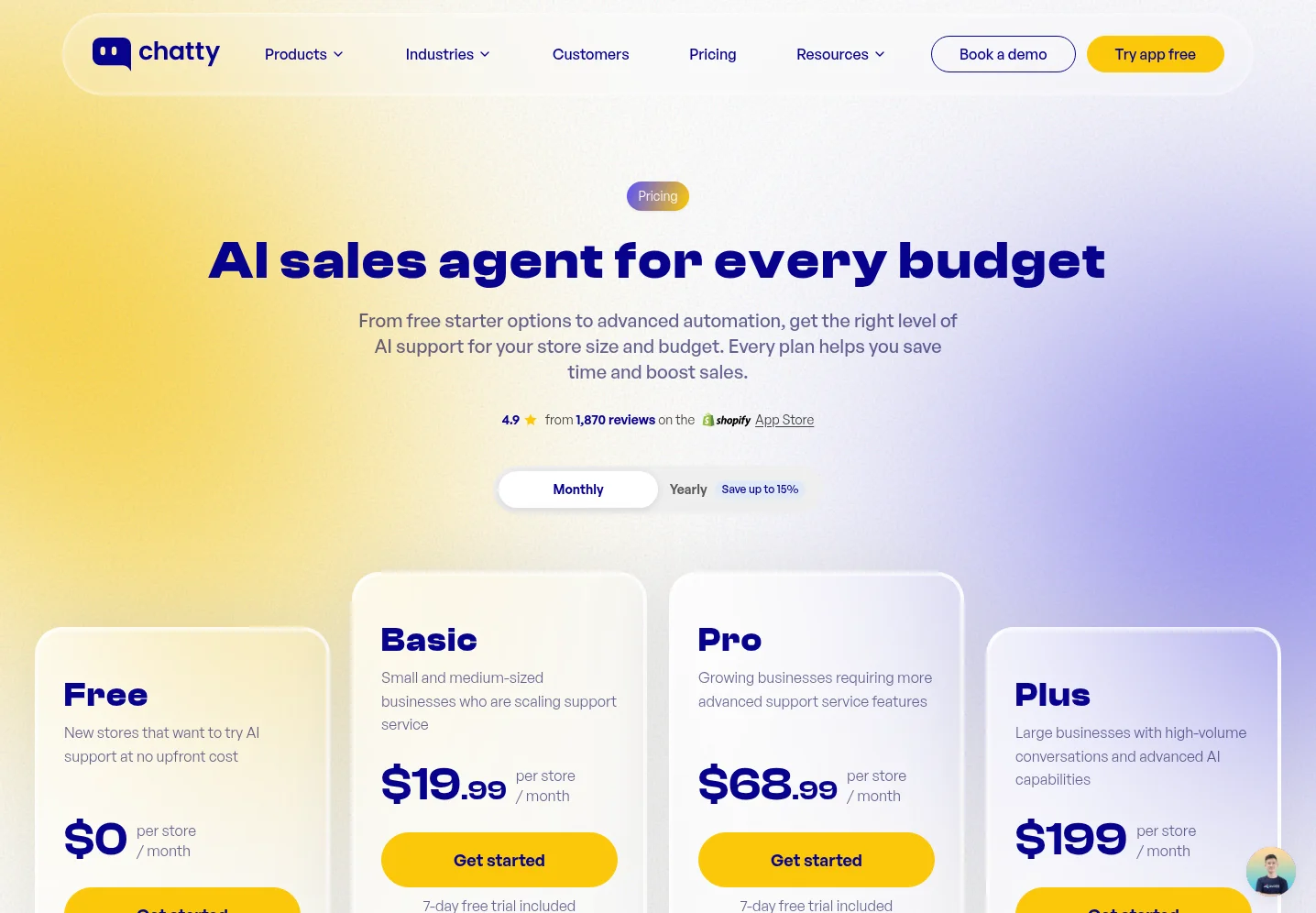
Pricing: Free is $0 (50 AI conversations a month, 200 products for AI training, 1 team member, 90-day chat history). Basic is $19.99/month (100 AI conversations, 500 products, 5 team members). Pro is $68.99/month (500 AI conversations, 8,000 products, 10 team members, unlimited history). Plus is $199/month (1,000 AI conversations, 20,000 products, unlimited team members). Paid plans have a 7-day free trial, and yearly billing saves up to 15%. Prices are from Chatty’s pricing page and Shopify App Store listing, checked on 7 October 2026.
Integrations: Shopify Flow, checkout, Klaviyo, Zendesk, WhatsApp, Messenger, Instagram and email, per its App Store listing.
Who it’s for: small and mid-sized stores that want an AI to answer product questions around the clock without paying helpdesk prices.
See how it compares: Chatty vs Emailwish.
5. Gorgias
Best for a full ecommerce helpdesk
Gorgias is a helpdesk first and a chat widget second. Email, chat, social, voice and SMS conversations land in one inbox, and its AI Agent can resolve tickets end to end and act as a shopping assistant. It’s priced by ticket volume, not by agent, which suits teams with several support staff. If chat is only one part of a bigger support operation, it belongs on your shortlist, and our roundup of the best helpdesk software for Shopify compares it with other full helpdesks.
What we liked
- Never priced per agent: Basic and above include unlimited support agents
- One inbox for chat, email, social and, as paid add-ons, voice and SMS
- More than 100 integrations, including Klaviyo, Attentive, Recharge, Yotpo and Aircall
Where it could improve
- Ticket limits are tight at the bottom: Starter includes 50 tickets a month, with $0.40 per extra ticket
- The AI Agent is a separate charge on top of the helpdesk price
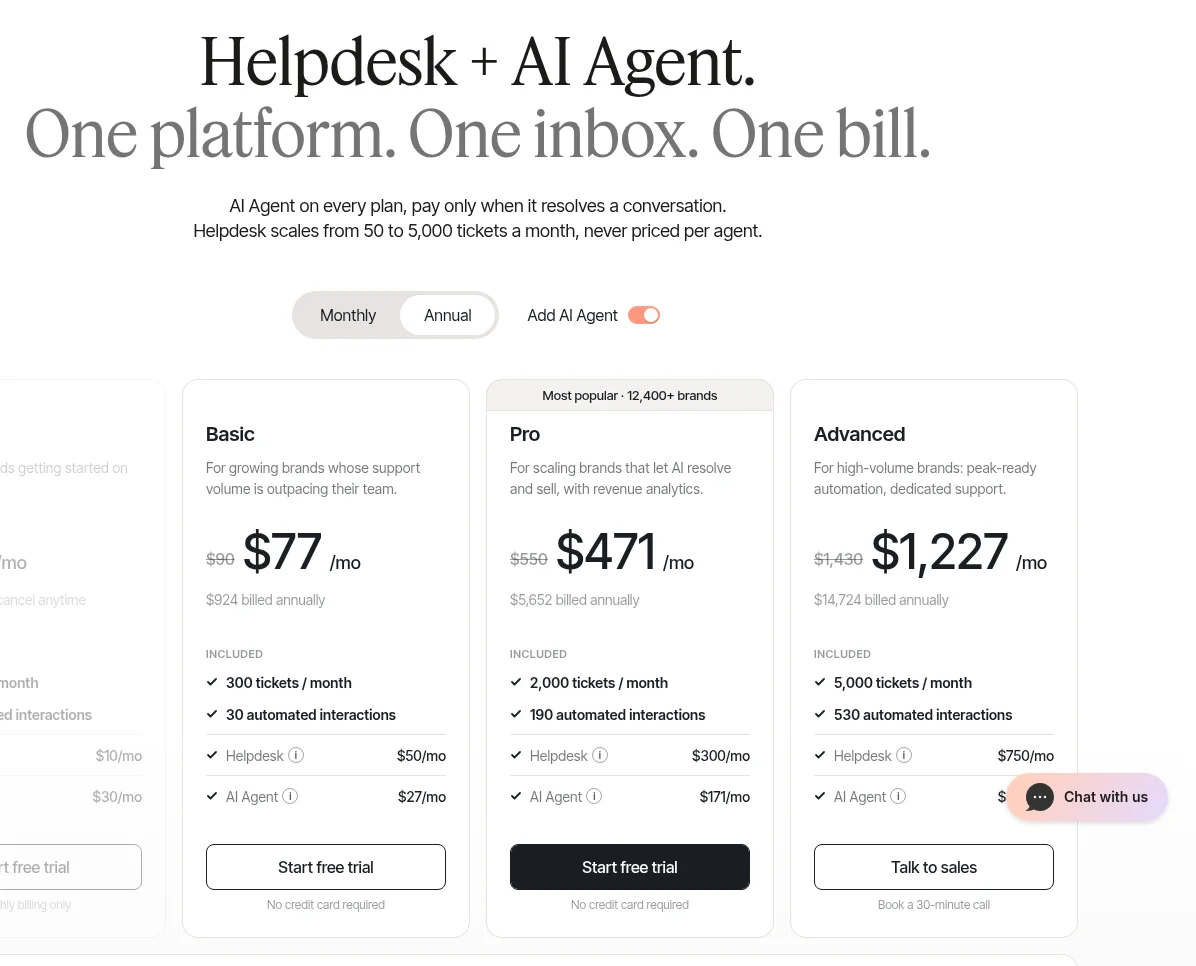
Pricing: the Shopify App Store listing shows Starter at $10/month (50 tickets, 3 agents, monthly billing only), Basic at $60/month (300 tickets), Pro at $360/month (2,000 tickets) and Advanced at $900/month (5,000 tickets). Billed annually, Gorgias’s pricing page lists the helpdesk at $50, $300 and $750 a month for Basic, Pro and Advanced. Adding the AI Agent raises those to $77, $471 and $1,227 a month billed annually. There’s a free trial, with no credit card required.
Who it’s for: stores with a dedicated support team handling hundreds or thousands of tickets a month.
See how it compares: Gorgias vs Emailwish.
6. Chatra
Best for small teams that want a human-first chat
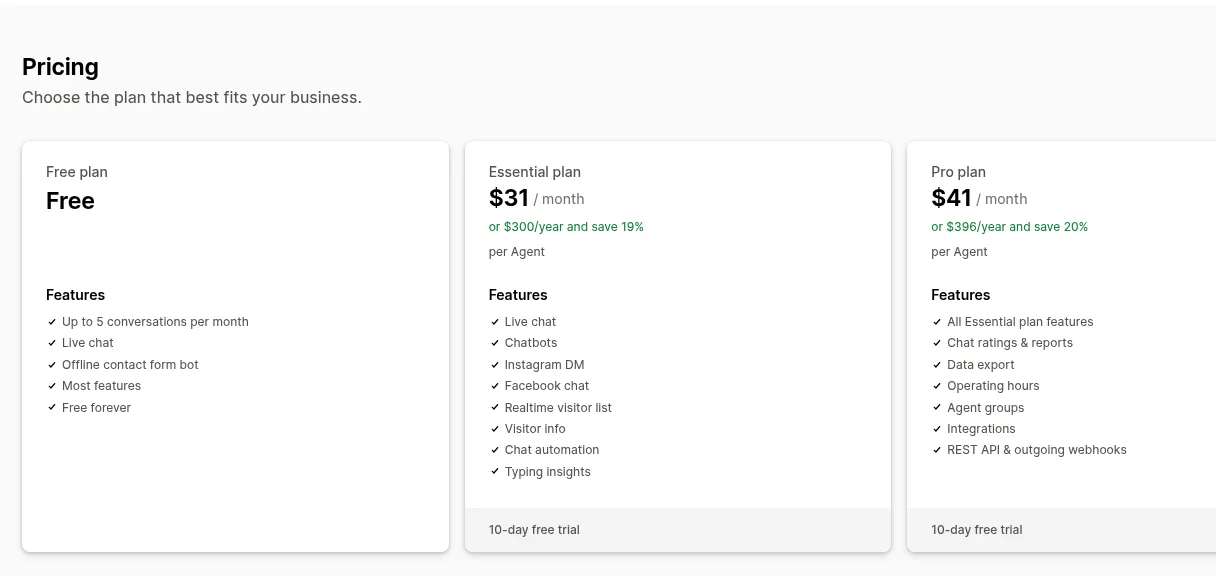
Chatra is a straightforward live chat built around people answering people. Its Shopify listing describes live chat, chatbots, a shared inbox and a Cart Saver tool that lets you reach out proactively to shoppers stuck at checkout. You can see who’s on your site, where they’re from and what’s in their cart, and answer Facebook, Instagram and email messages from the same app on desktop or mobile.
What we liked
- Seeing a visitor’s cart while you chat makes checkout rescues practical
- Facebook chat and Instagram DMs are included from the Essential plan
- Desktop and mobile apps for Windows, Mac, Android and iOS
Where it could improve
- The free plan is very small: up to 5 conversations a month, as listed on the App Store
- Per-agent pricing adds up as your team grows, and operating hours, reports and integrations need Pro
Pricing: Free (up to 5 conversations a month, live chat and an offline contact form bot). Essential is $31 per agent per month, or $300 a year. Pro is $41 per agent per month, or $396 a year. A free trial is available. Prices are from Chatra’s Shopify App Store listing; its own pricing page wasn’t reachable when we checked.
Who it’s for: small teams that answer chats themselves and want a clean, focused tool rather than a full helpdesk.
See how it compares: Chatra vs Emailwish.
7. tawk.to
Best for free unlimited agents
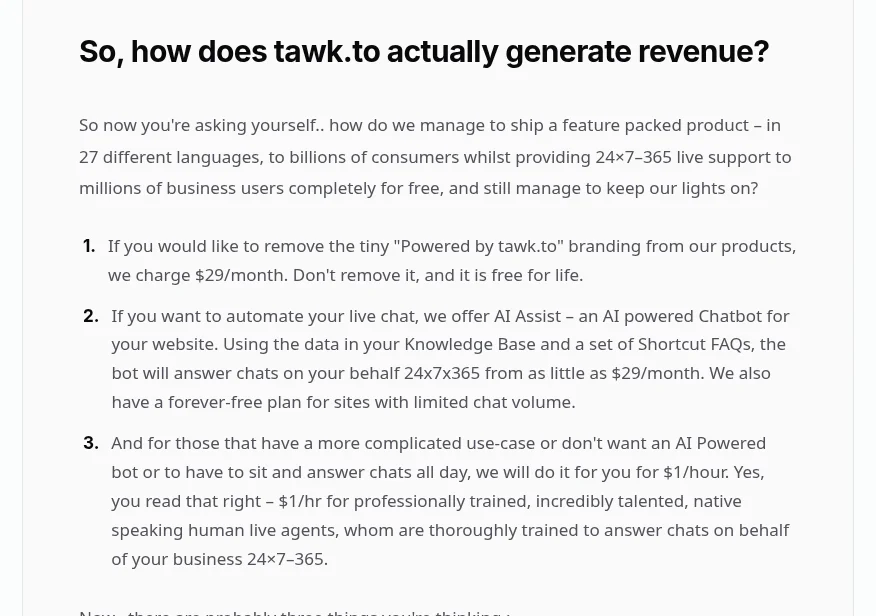
tawk.to gives you its chat software free, with unlimited messaging, ticketing and agent seats. It makes money from add-ons instead: removing its branding, an AI chatbot, and trained human agents who answer chats for you. Its Shopify app lets you view and manage Shopify orders from chats and tickets, and it comes with a CRM, a knowledge base and apps for iOS, Android, Windows and Mac.
What we liked
- Free for unlimited agents, so adding seasonal helpers costs nothing
- Shopify orders are visible and manageable from chats and tickets
- Hired chat agents from $1 an hour if you can’t staff the chat yourself
Where it could improve
- The lowest App Store rating on this list after Zendesk: 3.6 from 89 reviews
- The free widget shows “Powered by tawk.to” unless you pay to remove it
Pricing: free. Removing the branding costs $29/month. AI Assist, its AI chatbot, starts at $29/month, with a forever-free plan for sites with limited chat volume. Hired chat agents cost $1 an hour. Prices from tawk.to’s own explanation of its pricing.
Who it’s for: stores that need several people on chat but have no budget for seats. For more no-cost options, see our list of the best free live chat apps for Shopify.
See how it compares: tawk.to vs Emailwish.
8. Zendesk
Best for multi-channel service teams already on Zendesk
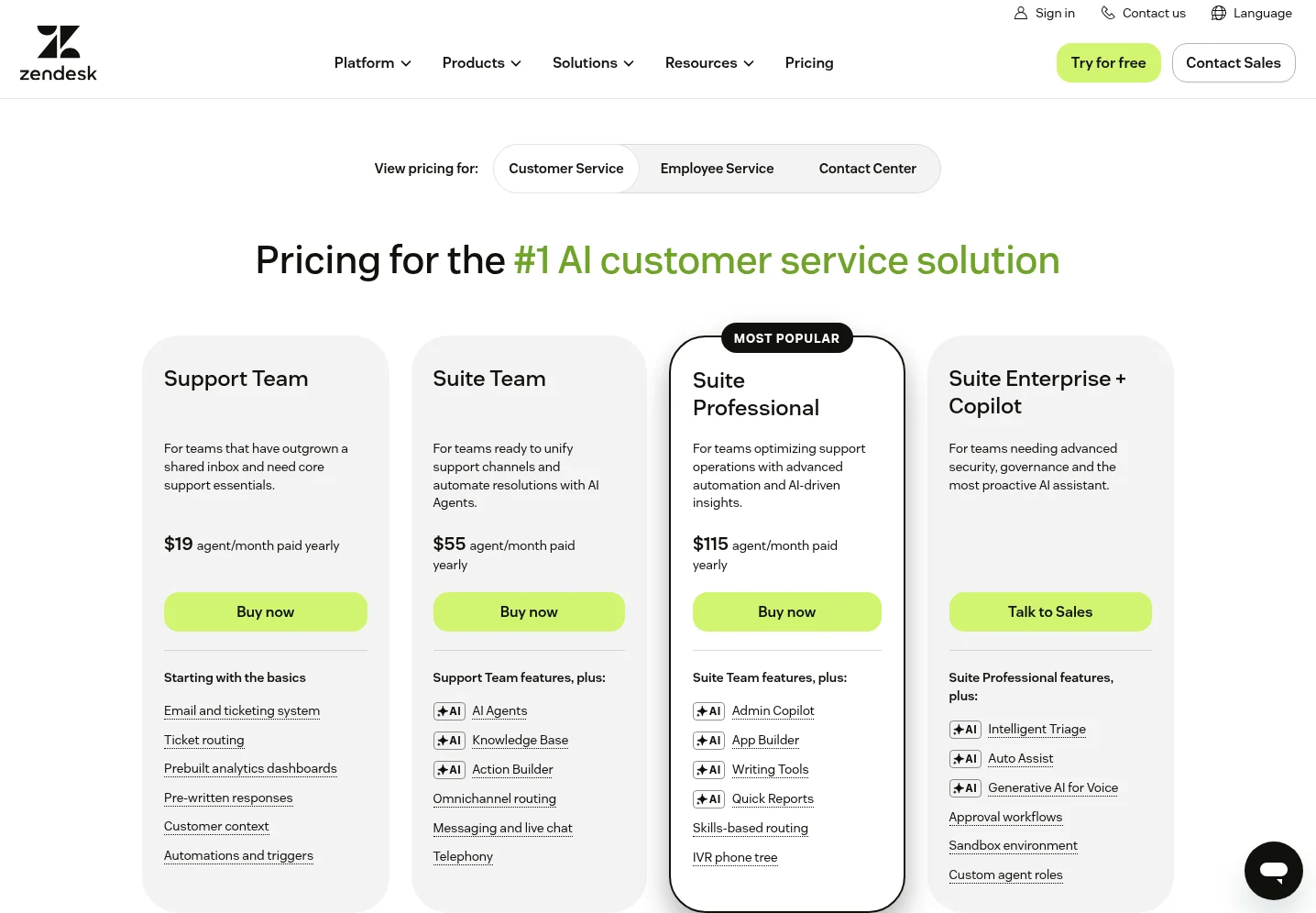
Zendesk is an enterprise customer service platform covering messaging, phone, chat, email and social. Its Shopify app puts customer data in the Zendesk sidebar so agents can process refunds and cancellations without leaving the conversation, and embeds live chat in your storefront. It makes sense if your company already runs support on Zendesk across several brands or channels.
What we liked
- AI agents, a knowledge base and omnichannel routing from Suite Team
- Refunds and cancellations from inside the support sidebar
- Scales to large teams with skills-based routing and IVR on higher plans
Where it could improve
- Per-agent pricing is the highest on this list, and the cheapest plan (Support Team, $19) doesn’t list messaging and live chat; they start at Suite Team
- A 3.2 rating from 93 reviews on the Shopify App Store, the lowest here
Pricing: Support Team is $19 per agent per month billed yearly (email and ticketing). Suite Team, the first plan with messaging and live chat, is $55 per agent per month billed yearly. Suite Professional is $115 per agent per month billed yearly, and Suite Enterprise is priced by sales. The Shopify App Store listing shows a 14-day free trial. Prices from Zendesk’s pricing page.
Who it’s for: established brands with a support team already on Zendesk, or with complex routing and security needs.
See how it compares: Zendesk vs Emailwish.
Should you use one app or many?
Most Shopify stores collect apps one problem at a time: a chat app, then an email app, then reviews, popups and a wishlist. Each has its own subscription and setup, and they only share data through integrations that can lag, break after an update, or pass across less than you’d expect.
The bigger cost is the signal you lose. A chat app knows a shopper asked about the blue jacket in medium. Your email app knows they abandoned a cart. Unless the two share a customer profile, nobody connects those facts, and the follow-up email is generic. Emailwish runs chat, email, reviews, popups and wishlists on one profile, so a chat can trigger a flow and shape a segment directly. If you have a large support team and complex ticket routing, a dedicated helpdesk like Gorgias or Zendesk is still the right call. If you’re a small team, fewer apps usually means faster results and a clearer picture of each customer.
Which one is right for your store?
Here’s how Emailwish fits each type of store, based on your team and the questions you get most.
| Your store | Our pick | Why |
|---|---|---|
| Brand-new store, no budget | Emailwish (free Seed plan) | Live chat with AI answers and order tracking, 4 team seats and unlimited conversations, free |
| Small team that wants chat to drive email sales | Emailwish Launch ($35/month) | Chats trigger follow-up emails, and every chat sits on the same customer profile as email, reviews and popups |
| Lots of “where’s my order?” questions | Emailwish | Shoppers get order status and delivery tracking right in the chat, on every plan |
| Want 24/7 AI answers on a small budget | Emailwish | AI answers about orders, shipping and products are included on every plan with no per-conversation fee. Chatty’s free plan stops at 50 AI conversations a month |
| Dedicated support team, high volume | Emailwish Growth ($100/month) | 10 team seats in one inbox built around products and orders, with unlimited conversations (50 seats on Enterprise) |
| Several part-time helpers, tight budget | Emailwish | 4 seats on Free and 6 on Launch, with no per-agent fee. Chatra and Zendesk charge per agent |
| One or two people answering chats by hand | Emailwish | A simple widget and team inbox, with the customer’s cart and orders next to the conversation |
| Large store with a big support team | Emailwish Enterprise ($1,000/month) | 50 team seats and 480,000 emails a month on one plan |
Whichever plan you pick, the widget is only half the job. A short set of saved replies for your top ten questions makes any chat faster; our live chat scripts are a good starting point, and our live chat best practices cover response times and handoffs. If you also run a WooCommerce store, our list of the best chat apps on WooCommerce compares plugins built for that platform.
FAQ: top chat apps on Shopify
1. What is the best free chat app for Shopify?
Shopify Inbox is free and includes an AI sales associate trained on your catalog and policies. tawk.to is free with unlimited agents, and Chatty, Tidio, Chatra and Emailwish all have free plans. The limits differ a lot: Chatty’s free plan includes 50 AI conversations a month, Tidio’s 50 billable conversations, and Chatra’s up to 5 conversations, while Emailwish includes live chat, AI answers and order tracking on its free Seed plan alongside email. Emailwish is best for chat that triggers email follow-ups.
2. Is Shopify Inbox good enough?
For many new stores, yes. It’s free, connects to your catalog automatically and can answer product questions with AI. It falls short when you need a team helpdesk with ticket routing, or when you want chats to trigger follow-up emails and segments. That’s when stores move to a helpdesk like Gorgias or an all-in-one app like Emailwish.
3. Do I need an AI chatbot?
Only if chats arrive when nobody can answer them, or the same questions repeat all day. AI is most useful for order status, shipping and product questions. Before you switch it on, check what each answer costs (Chatty charges $0.40 per extra AI conversation, for example) and set a usage cap. Emailwish includes AI answers and order tracking in chat on every plan, including Free, at no extra charge.
4. Does live chat increase conversions?
It can, because it removes the doubts that stop a purchase: sizing, delivery dates, returns and stock. The effect depends on response time and on what happens after the chat. A shopper who chatted and didn’t buy is a warm lead. Following up with an email about the product they asked about, alongside your abandoned cart emails, turns more of those chats into orders.
5. Can a Shopify chat app send follow-up emails after a chat?
Most chat apps can’t on their own. They rely on an integration with your email tool, if one exists. Emailwish includes a chat follow-up email series among the flows it sets up at install, and can trigger emails from chat activity because chat and email share one customer profile.
6. Which is cheaper: per-agent or per-conversation pricing?
It depends on your team and your season. Per-agent pricing (Chatra, Zendesk) suits one or two people handling many chats. Per-ticket or per-conversation pricing (Gorgias, Tidio) suits bigger teams with steady volume, but rises during sales. Compare the cost in your busiest month, not your average one.
Top Chat Apps on Shopify: Conclusion
All eight apps put a working chat bubble on your store. The real differences are what the chat knows (your orders, cart and catalog), who answers it (your team, an AI, or hired agents), how the bill grows, and whether the conversation leads anywhere once it ends. Shopify Inbox is the sensible free start. Tidio and Chatty are the AI picks, Gorgias and Zendesk the helpdesks for real support teams, and Chatra and tawk.to the simple, low-cost options.
If you want chat that does more than answer, with every conversation feeding the same customer profile as your emails, reviews and popups, install Emailwish free from the Shopify App Store. Live chat is on every plan, including Free. Compare more tools on our live chat comparison hub or read our guide to live chat for ecommerce.
Disclosure: Emailwish is our own product and is listed first. Every other tool was judged against the same criteria using its public pricing and Shopify App Store listing as of October 2026. We earn no affiliate commissions.
We keep our content up to dateSee latest updates
- – Full rewrite: prices checked on 1 Oct 2026, Shopify Inbox replaces Facebook Messenger, Chatty and Emailwish added, JivoChat removed, comparison table, buying guide, methodology and FAQ added.
- – Published


Written and fact-checked under our editorial policy. About Emailwish.