
A popup is the fastest way to turn a first-time visitor into a subscriber, and also the fastest way to annoy one. The top popup apps on Shopify are the ones that do the first without the second: they show the right offer at the right moment, they look good on a phone, and they send every new signup straight into an email flow that actually follows up. This guide is written for Shopify merchants who want to build an email list without hurting the shopping experience. If you sell on more than one platform, our guide to the best popup builders for ecommerce covers tools beyond Shopify.
We compared eight popup apps that are live on the Shopify App Store today, using each app’s current listing, its public pricing and its App Store rating as of October 2026. We dropped apps from the earlier version of this post that are either no longer available (Better Coupon Box, Popup Window) or aren’t really popup apps (Quick Announcement Bar is a bar, and Sales Pop shows “someone just bought” notifications rather than signup forms).
The 8 best popup apps on Shopify
Here’s our list of the 8 top popup apps on Shopify, ranked:
- Emailwish: best for popups that feed straight into done-for-you email flows
- OptiMonk: best for AI-built, fully custom popups and A/B testing
- Privy: best for popups plus email and SMS in one subscription
- Poptin: best for a generous free plan and lots of popup types
- Justuno: best for high-traffic stores that want strategy help
- Wisepops: best for large brands that want popups, web push and an on-site feed
- Mailmunch: best for forms and landing pages on a tight budget
- Pixelpop: best for simple popups at the lowest price
- NavonaAI: best for preventing cart abandonment
Quick comparison: top popup apps on Shopify
| App | Best for | Paid plans from | Free plan | Visitor limits | Shopify App Store rating |
|---|---|---|---|---|---|
 Emailwish Emailwish |
Popups wired into email flows, reviews and chat | $35/mo | Yes100 contacts, 1,000 emails/mo | UnlimitedNo visitor, pageview or popup-view caps | (7 reviews) |
 OptiMonk OptiMonk |
AI-built custom popups and testing | $29/mo(20,000 pageviews) | Yes10,000 pageviews/mo | Capped by pageviews10,000/mo free, 20,000 on $29 | (459 reviews) |
 Privy Privy |
Popups plus email and SMS | $24/mo(popups only, 10,000 pageviews) | No | Capped by pageviews10,000/mo on the $24 popup plan | (4,213 reviews) |
 Poptin Poptin |
Free plan and popup variety | $25/mo(10,000 visitors) | Yes1,000 visitors/mo | Capped by visitors1,000/mo free, 10,000 on $25 | (343 reviews) |
 Justuno Justuno |
High-traffic stores wanting expert help | $59/mo(10,000 visitors) | No14-day trial | Capped by visitors10,000/mo on $59 | (669 reviews) |
 Wisepops Wisepops |
Large brands, multi-format onsite marketing | $299/mo(500,000 pageviews) | No14-day trial | Capped by pageviews500,000/mo on $299 | (70 reviews) |
 Mailmunch Mailmunch |
Forms and landing pages on a budget | $24.99/mo | Yes | Priced by contacts+$15 per 5,000 contacts on Premium | (148 reviews) |
 Pixelpop Pixelpop |
Simple, cheap popups | $6/mo(1,000 popup views) | Yes100 popup views/mo | Capped by popup views100/mo free, 1,000 on $6 | (90 reviews) |
Prices are the starting monthly price on each app’s Shopify App Store listing or the vendor’s own pricing page in October 2026. Most popup apps charge by traffic (pageviews or visitors), so check the plan that matches your monthly visits. For head-to-head pages, browse all our popup app comparisons.
What to look for in a Shopify popup app
Most popup apps can show a box with an email field. The differences that matter show up after the first week, when you’re trying to grow the list without driving shoppers away. These are the things we’d check before installing any of them. For design and copy tips once a popup is live, see our email popup best practices.
How it charges. Popup apps price in very different ways. Some charge by pageviews (OptiMonk, Wisepops, Privy‘s popup plan), some by unique visitors (Poptin, Justuno), some by how many times a popup is shown (Pixelpop), and some by contacts or emails sent (Emailwish, Mailmunch). A store with 30,000 monthly visitors and a small list will pay very different amounts depending on the model. Work out your monthly visitors and pageviews in Shopify Analytics first, then compare plans at that number, not at the headline price.
Where the email goes next. A popup only collects the address. What earns money is the welcome series, the first-order discount reminder and the abandoned cart flow that follow. If the popup app doesn’t send email itself, it has to sync to your email tool, and every sync is another setting that can break. Ask whether a signup can start a flow within seconds, and whether the popup’s answers (for example, “shopping for: gifts”) land on the customer profile your emails use.
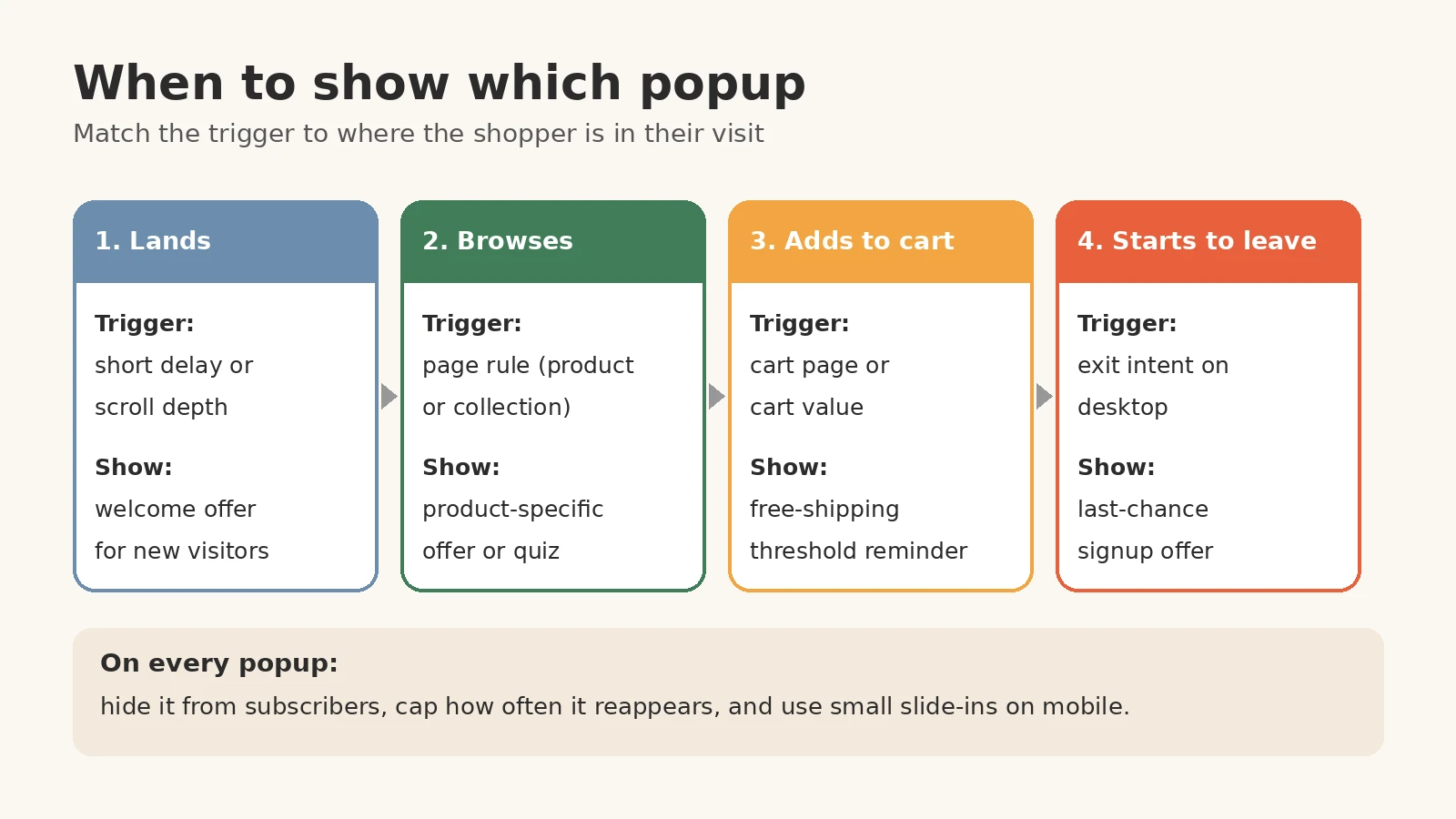
Triggers and targeting. At a minimum you want a time delay, scroll depth, exit intent popups and page rules, so a shopper on a product page sees a different offer from one reading your shipping policy. Better apps also let you hide popups from existing subscribers and recent buyers, and cap how often a popup can reappear.
Mobile behaviour. Most Shopify traffic is on phones, and Google’s guidance warns against intrusive interstitials that cover the main content on mobile. Look for small mobile layouts (slide-ins, bottom bars, teasers that open a form only when tapped) and the ability to set different rules for mobile and desktop.
Popup types you’ll actually use. Spin-to-win wheels, multi-step forms, quizzes and countdown timers can lift signups, but most stores run two or three campaigns well rather than ten badly. For inspiration, browse these email popup examples. If gamified popups are the main thing you want, see our list of the best spin the wheel apps for Shopify.
Testing and reporting. A/B testing tells you whether a 10% or a free-shipping offer works better for your store. Revenue reporting tells you whether the subscribers you collected ever bought anything. Signup counts alone can hide a popup that attracts discount hunters who never come back. To judge your numbers, see what a good popup conversion rate looks like.
Speed and branding. Every app adds a script to your storefront. Check that the app loads asynchronously, and on free plans check whether it adds its own branding to your popup.
1. Emailwish
Best for popups that feed straight into done-for-you email flows
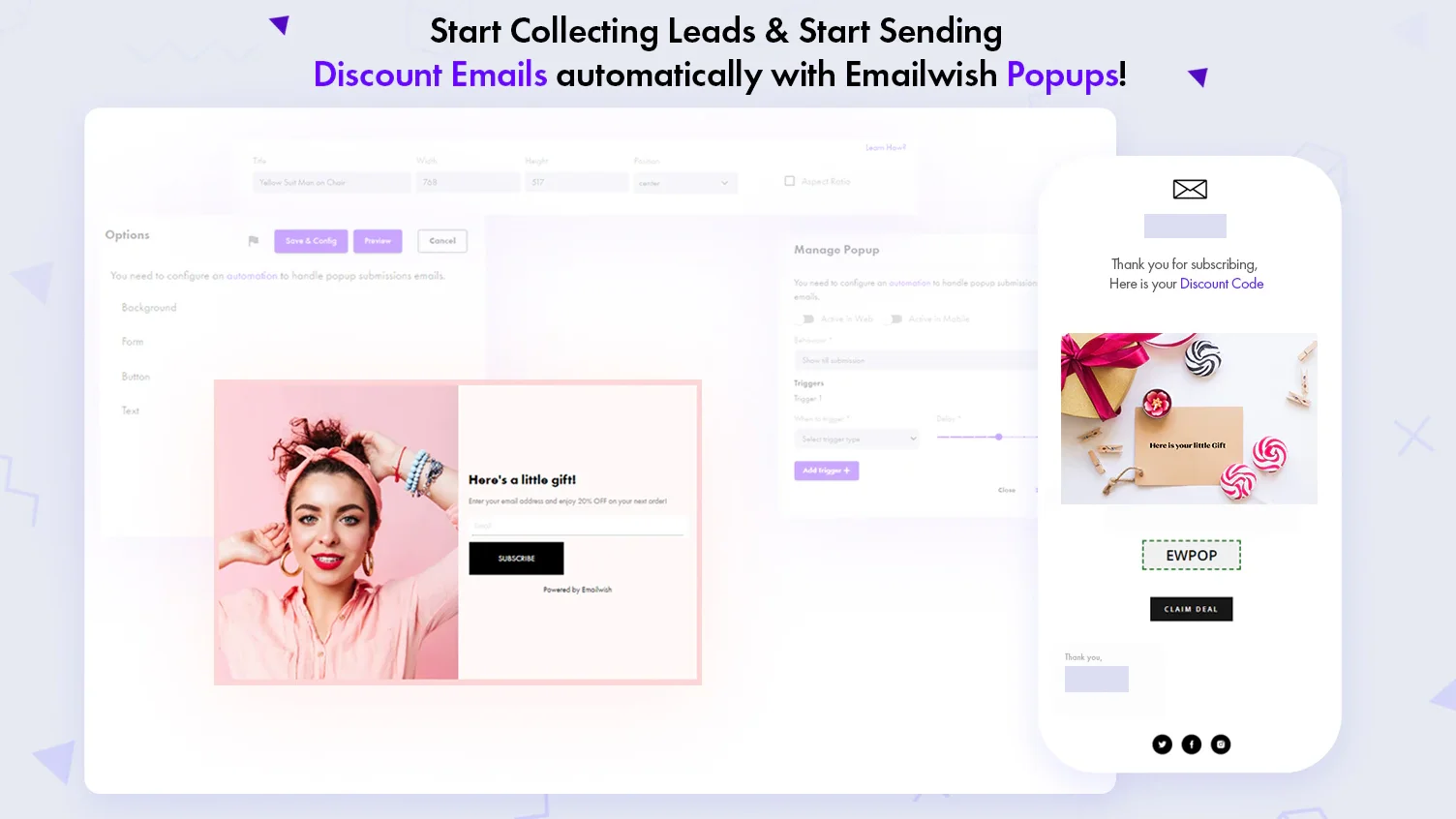
Emailwish (that’s us) is an all-in-one marketing app for Shopify that puts popups and forms in the same place as email automation, product reviews, live chat and wishlists. That matters for popups because a signup doesn’t have to travel anywhere. The moment someone subscribes, they land on one customer profile and the welcome flow starts, with no sync to another app in between.
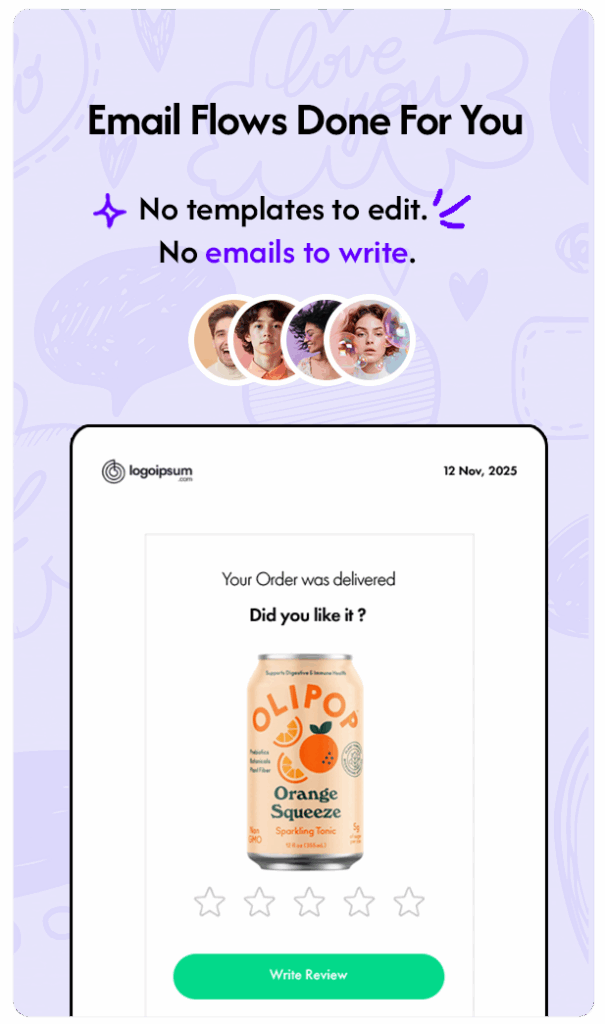
The Shopify popup app supports timed, exit-intent and page-rule (URL) targeting and multi-step forms, and approved product reviews can be shown inside popups as social proof. Because popup activity is a trigger like any other, you can send follow-ups based on what a shopper did across the store. For example, you can email a subscriber who signed up through a popup, then started a chat about a product, but didn’t buy. When you install Emailwish, it pulls your store name, logo, products and brand details from Shopify and sets up about 10 ecommerce email flows for you, including welcome, form signup, abandoned cart and review request.
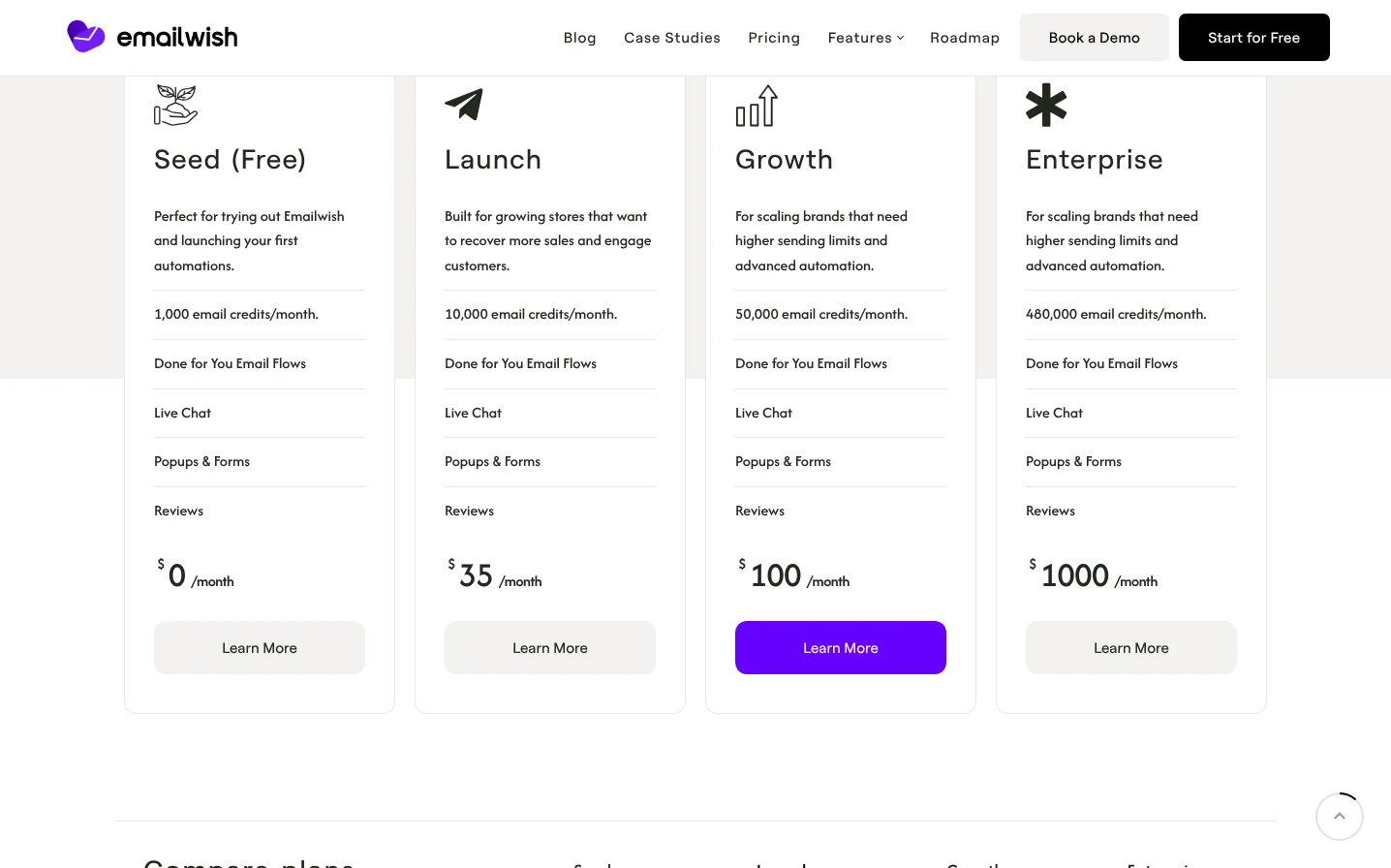
Pricing (as of October 2026): Seed is free (1,000 emails a month, 100 contacts). Launch is $35 a month (10,000 emails, 5,000 contacts), Growth is $100 a month (50,000 emails, 50,000 contacts) and Enterprise is $1,000 a month. Every plan includes popups and forms, email automation, reviews and live chat, plus chat and email support. See the Emailwish pricing page.
What we liked
- No visitor limits. Popups show to all your traffic with no visitor, pageview or popup-view caps. Pricing is based on emails sent, so a traffic spike never pushes you into a more expensive plan.
- Popup signups start an email flow instantly, with no third-party sync to set up or maintain.
- Popup, chat, review and wishlist activity all sit on one customer profile, so you can target on more than just “subscribed”.
Where it falls short
- A/B testing for popups is coming soon, not available yet, so you can’t split-test offers inside the app today.
- Emailwish doesn’t send SMS. If collecting phone numbers for text marketing is core to your plan, Privy or Justuno is the better fit.
Best for: Small and mid-sized Shopify stores that want popups, email flows, reviews and chat in one app instead of four.
2. OptiMonk
Best for AI-built, fully custom popups and A/B testing
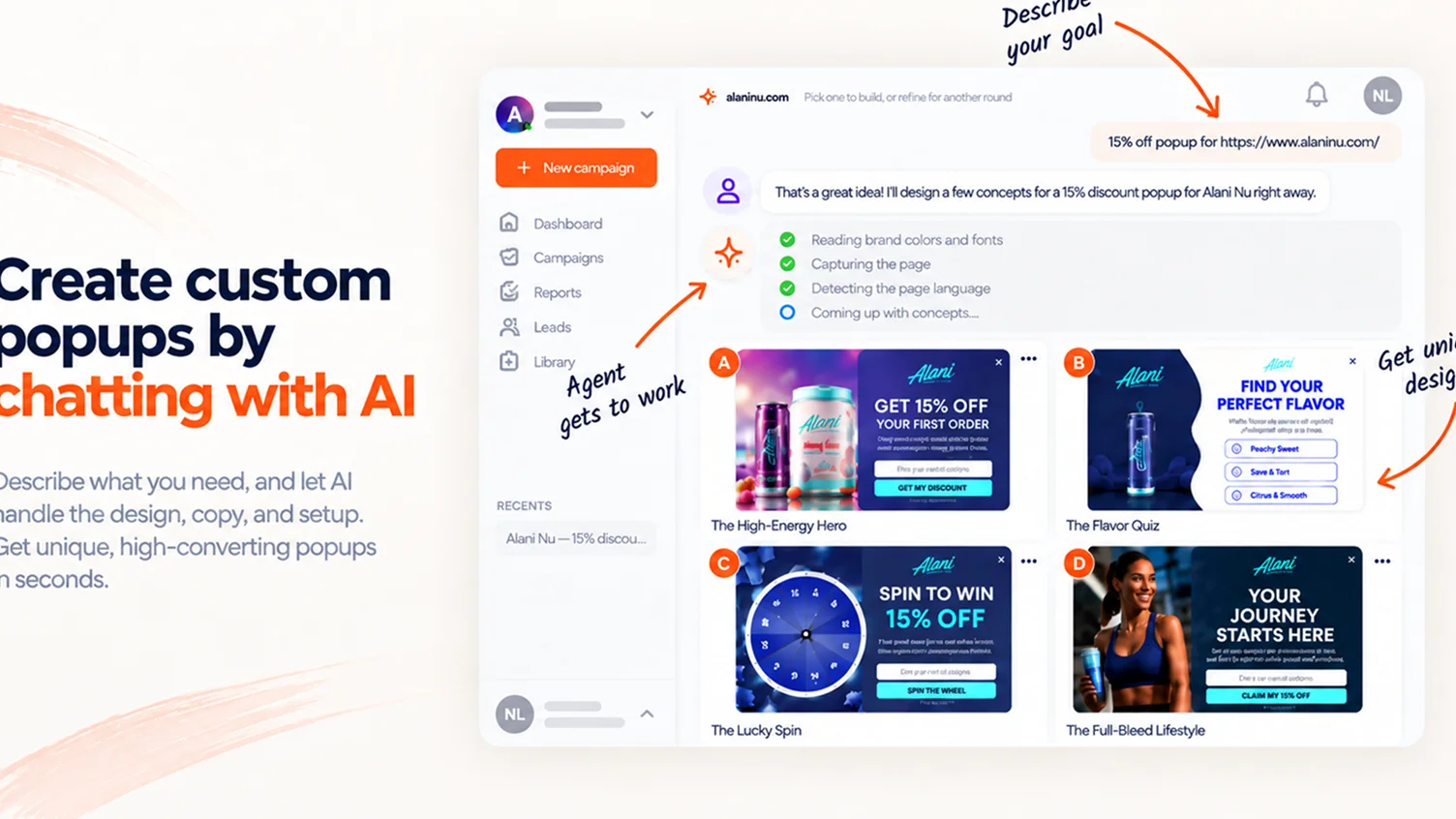
OptiMonk has rebuilt its Shopify app around an AI agent. Instead of starting from a template, you describe your goal and your website URL, and the agent designs an on-brand popup from scratch and suggests targeting, triggers and A/B tests. It can also read your store data, suggest new campaigns and build them on request, and it connects to MCP clients such as Claude, so you can edit popups from an AI chat.
Its App Store listing covers email, SMS, cart, exit-intent, discount, spin-the-wheel and countdown popups, and it integrates with Klaviyo, Mailchimp, ActiveCampaign, Attentive, Postscript and Google Analytics 4.
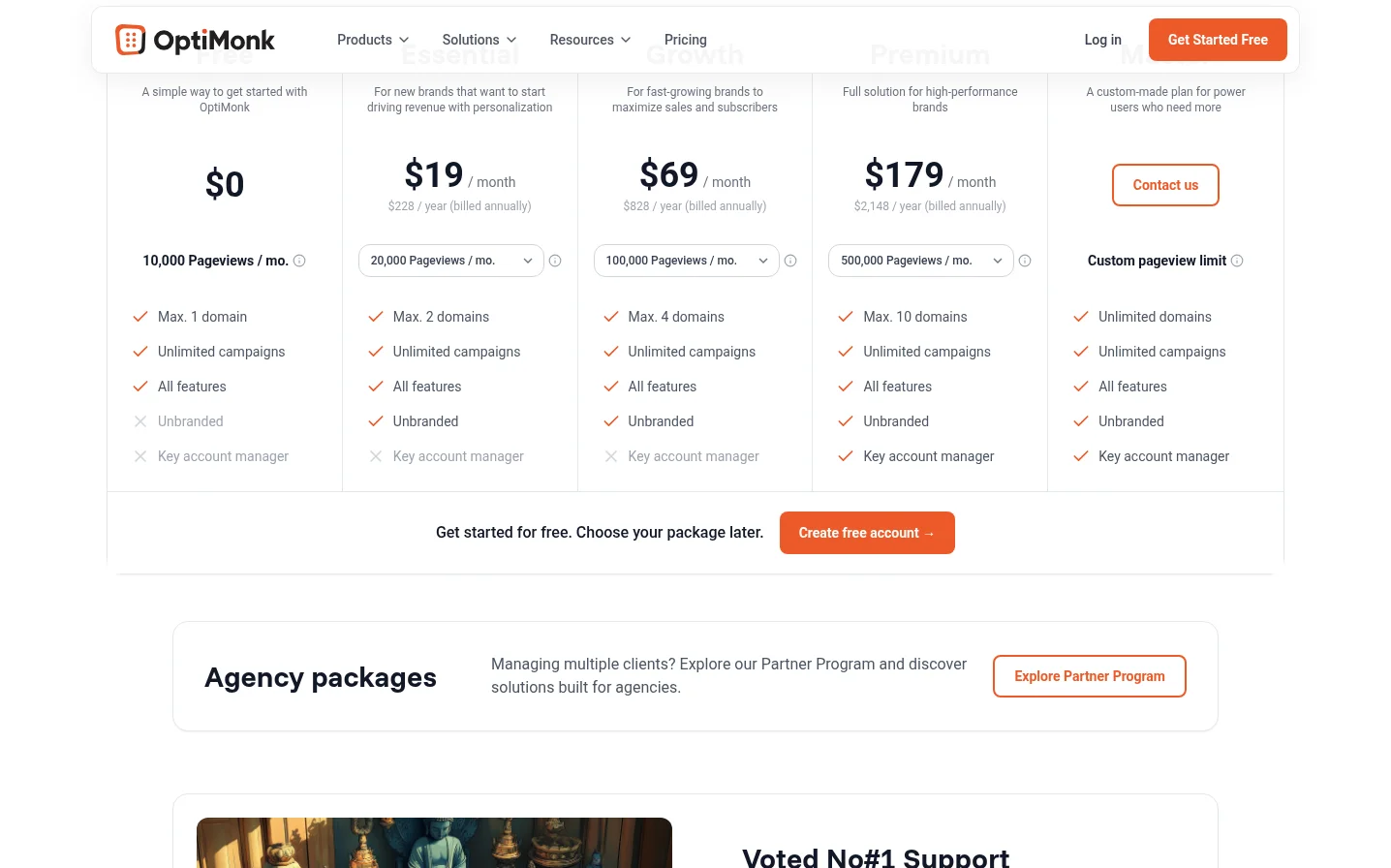
Pricing (as of October 2026): Free for 10,000 pageviews a month on one domain, with all features. Essential is $29 a month (20,000 pageviews, unbranded), Growth is $99 a month (100,000 pageviews) and Premium is $249 a month (500,000 pageviews, with a key account manager), billed through Shopify. OptiMonk’s own site shows lower monthly equivalents for annual billing. See OptiMonk pricing.
What we liked
- The free plan includes all features, not a stripped-down version, up to 10,000 pageviews.
- The AI agent builds a custom design rather than a recoloured template, which helps stores without a designer.
- A/B testing is built in, and the agent suggests headline and offer tests.
Where it falls short
- OptiMonk doesn’t send email, so every signup has to sync to a separate email platform before any follow-up goes out.
- Pricing is tied to pageviews, so a busy store can outgrow the free and Essential plans quickly.
Best for: Stores that already use Klaviyo or another email tool and want the most capable dedicated popup builder.
See how it compares: OptiMonk vs Emailwish.
3. Privy
Best for popups plus email and SMS in one subscription
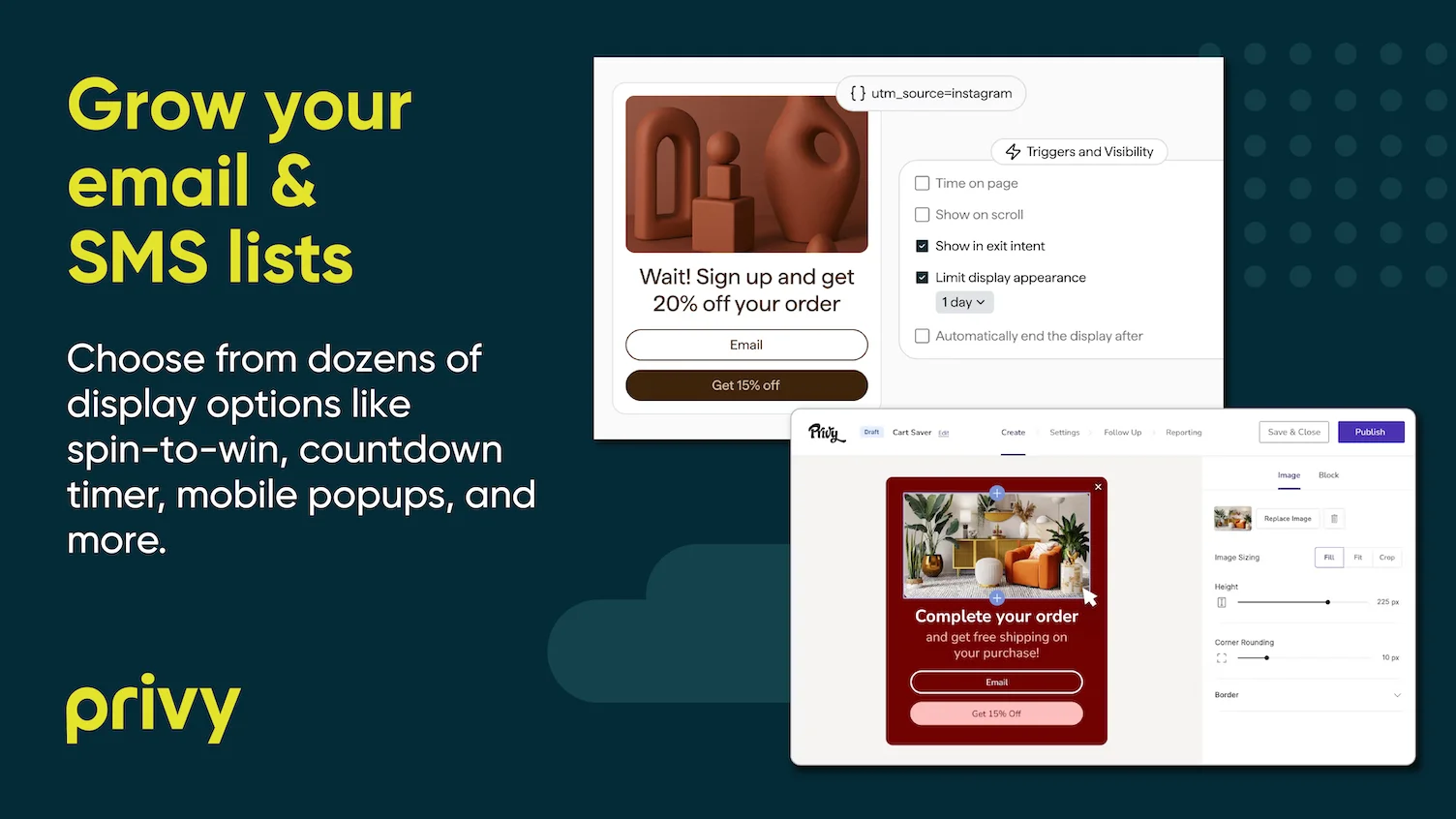
Privy is one of the best-known names in Shopify list growth, with more than 4,000 App Store reviews. It started as a popup tool and now covers email campaigns, automated flows and SMS as well, so you can run popups on their own or as part of a full email and SMS setup. Its popup tools include multi-step and mini-quiz forms and advanced targeting, and it syncs with Klaviyo, Mailchimp, Attentive and Postscript if you’d rather keep your existing email tool.
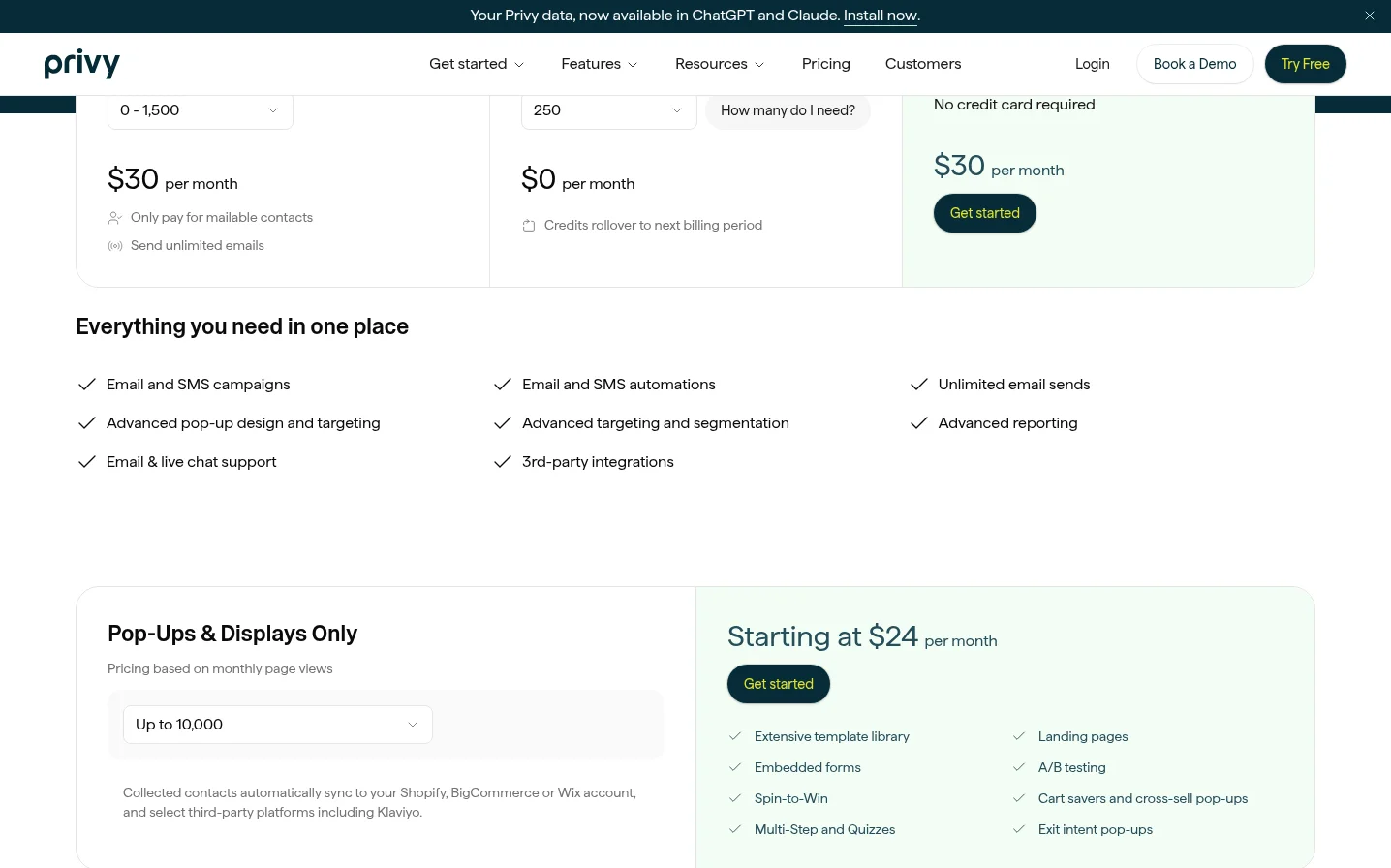
Pricing (as of October 2026): The Pop Ups & Displays plan starts at $24 a month for up to 10,000 monthly pageviews. The Email plan starts at $30 a month for up to 1,500 contacts and includes popups, and Email and SMS starts at $45 a month (1,500 contacts and 1,250 SMS credits). Dedicated strategists cost $150 a month extra. See Privy pricing.
What we liked
- You can start with popups only and add email and SMS later without switching apps.
- Popups, email and SMS share one platform, so signups flow into automations without a third-party sync.
- A huge review base and a long track record on Shopify.
Where it falls short
- There’s no free plan on the Shopify listing, and prices rise with both pageviews and contacts.
- Reviews, live chat and wishlists still need separate apps.
Best for: Stores that want SMS signups alongside email and are happy to pay for an established platform.
4. Poptin
Best for a generous free plan and lots of popup types
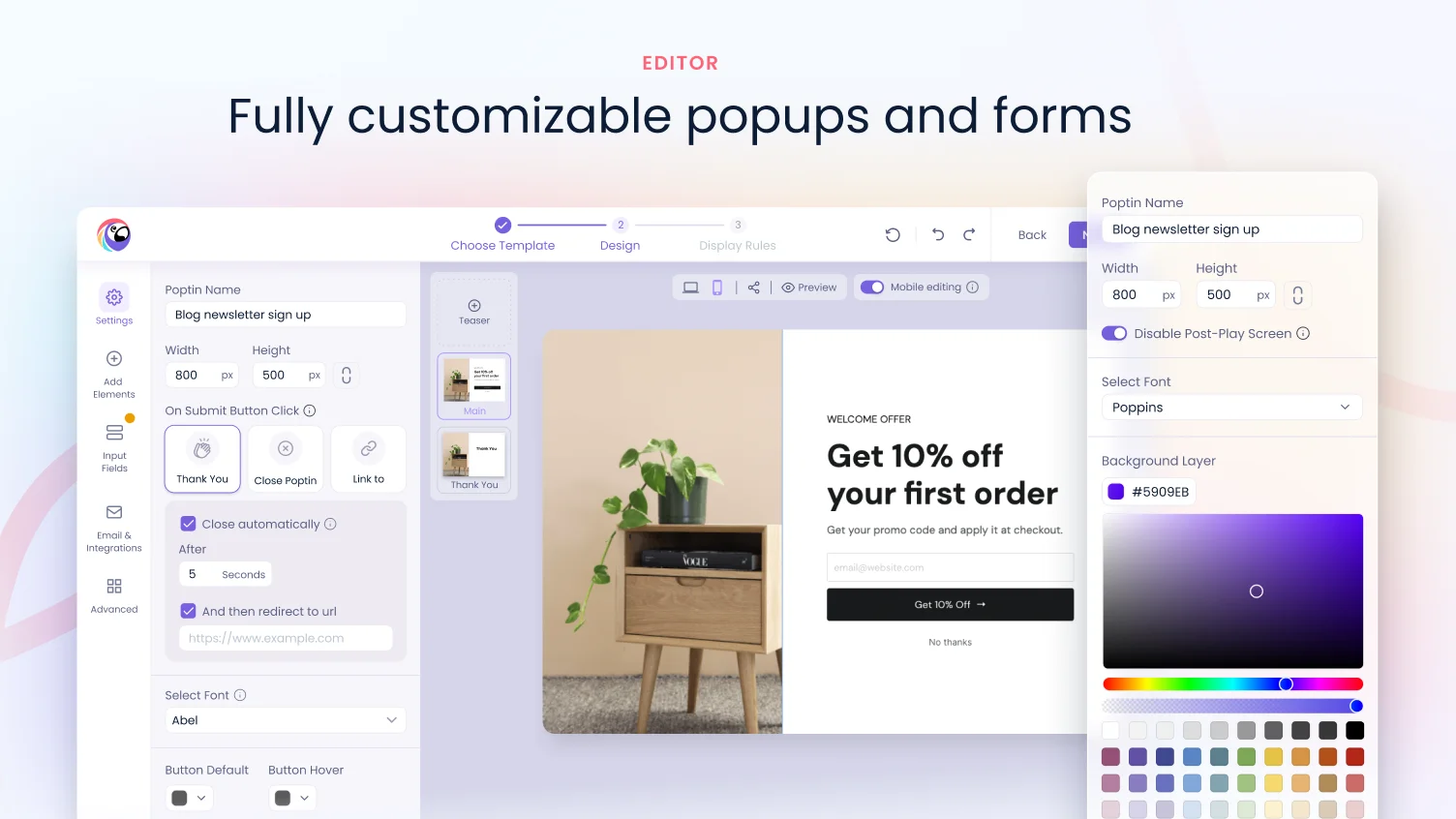
Poptin covers almost every popup format a Shopify store might want: lightbox email popups, exit-intent popups, discount and coupon popups, spin-the-wheel, notification bars, SMS popups and embedded forms. It includes a no-code builder, triggers and targeting rules, A/B testing and analytics, and connects to Klaviyo, Mailchimp, Omnisend, ActiveCampaign, HubSpot and Zapier. Paid plans include autoresponders, so you can send a basic follow-up email without a separate tool. It has the highest rating on this list, at 4.9 from 343 reviews.
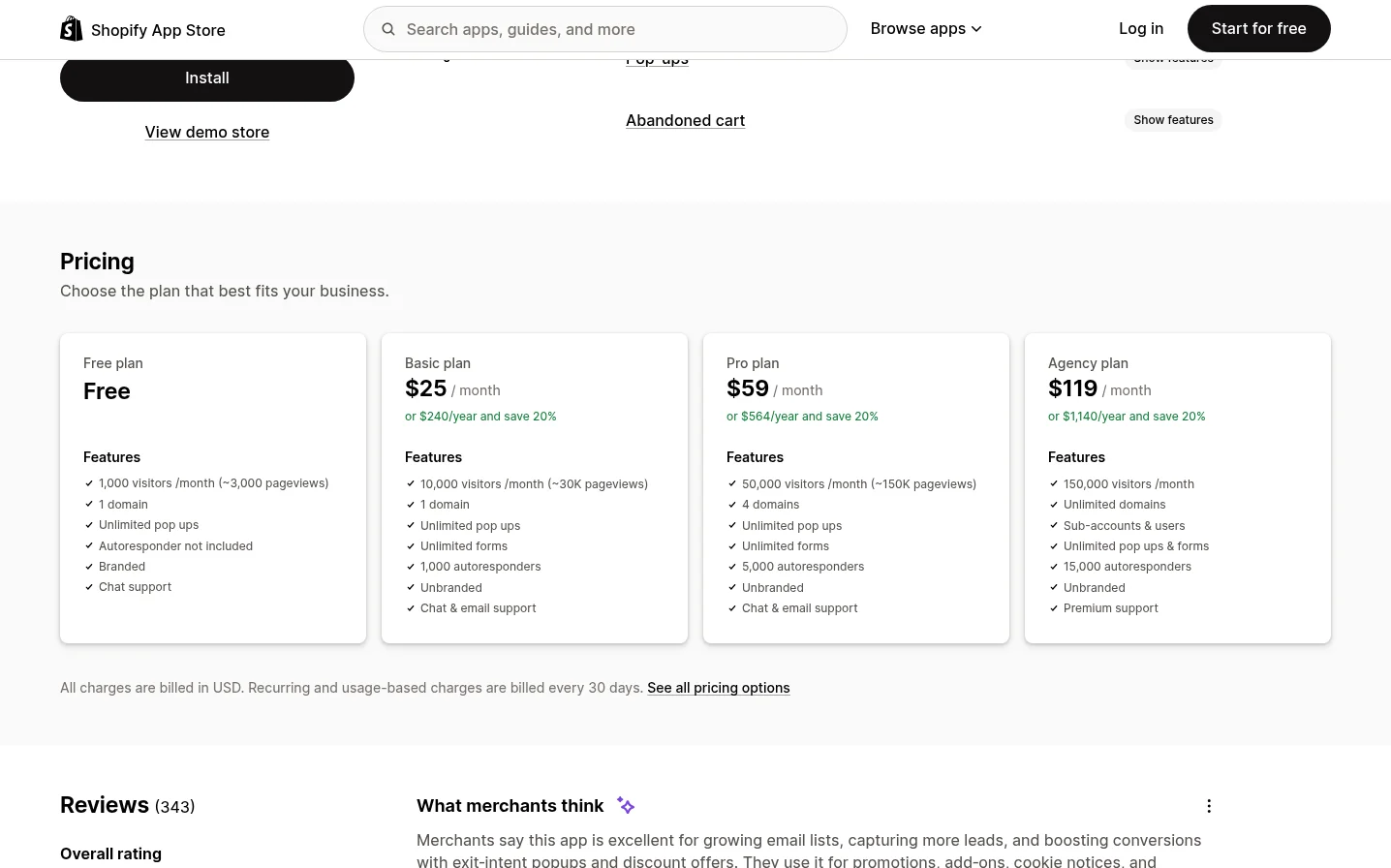
Pricing (as of October 2026): Free for 1,000 visitors a month (about 3,000 pageviews) on one domain, with Poptin branding and no autoresponder. Basic is $25 a month (10,000 visitors, 1,000 autoresponders, unbranded), Pro is $59 a month (50,000 visitors, four domains) and Agency is $119 a month (150,000 visitors, unlimited domains). Annual billing saves 20%. See Poptin pricing.
What we liked
- Very wide range of popup types, including SMS popups and spin-the-wheel, even on lower plans.
- A/B testing and targeting rules come as standard.
- Unlimited popups on every plan, including free.
Where it falls short
- The free plan’s 1,000-visitor cap is small, and it shows Poptin branding.
- Autoresponders cover simple follow-ups, not full abandoned cart or post-purchase flows, so you’ll still want one of the best email marketing apps for Shopify.
Best for: Small stores that want to try lots of popup formats for free before committing.
5. Justuno
Best for high-traffic stores that want strategy help
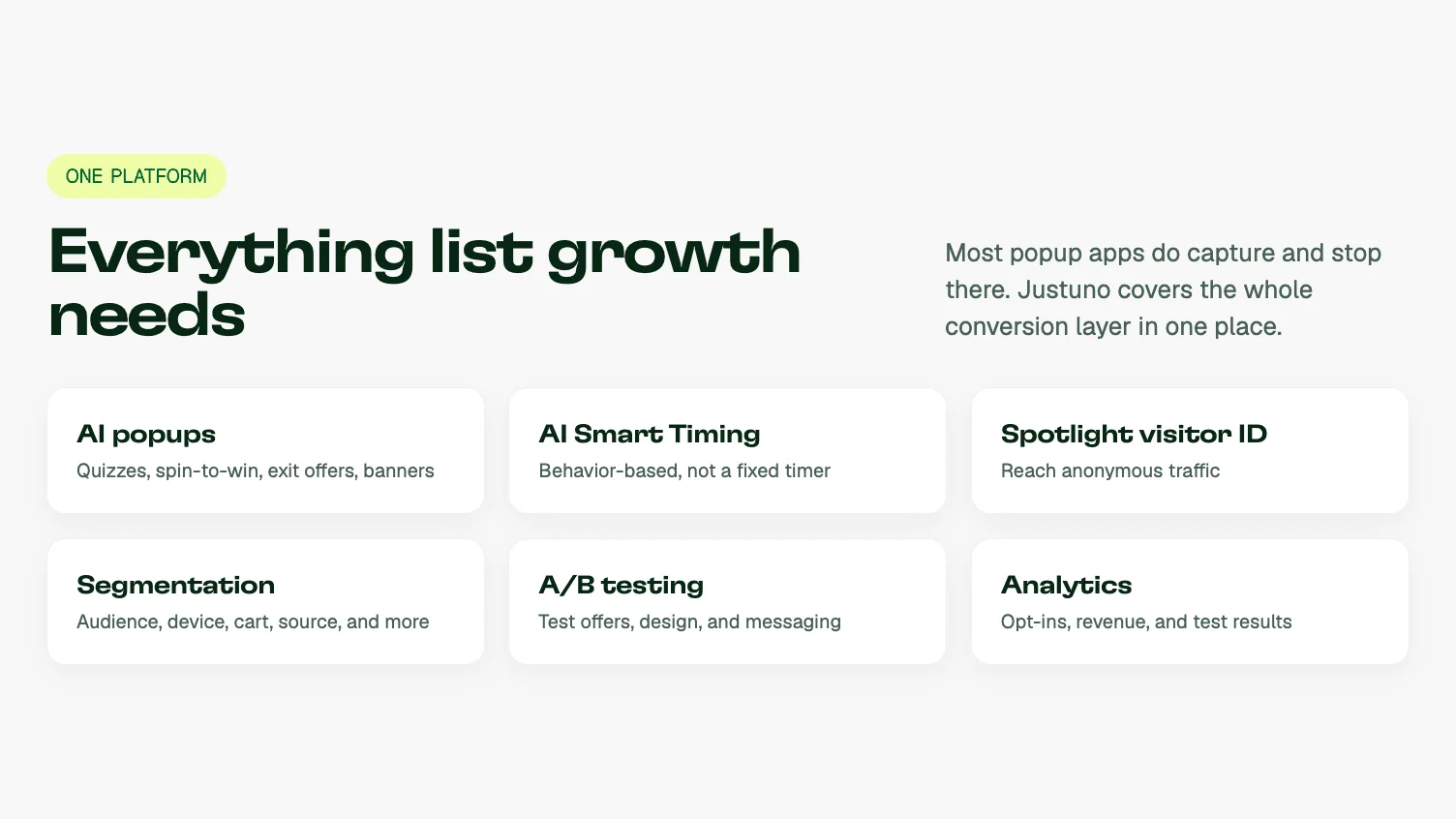
Justuno positions itself as a list-growth partner rather than just a popup builder. Alongside AI popups for email and SMS (quizzes, spin-to-win, exit offers and banners), it offers AI Smart Timing, which picks the moment to show each offer, and Spotlight, which identifies anonymous visitors to power abandonment flows in your email tool. Higher plans include white-glove onboarding, and Justuno sells done-for-you strategy and design from its own team. It integrates with Klaviyo, Attentive, Omnisend, Iterable and Postscript.
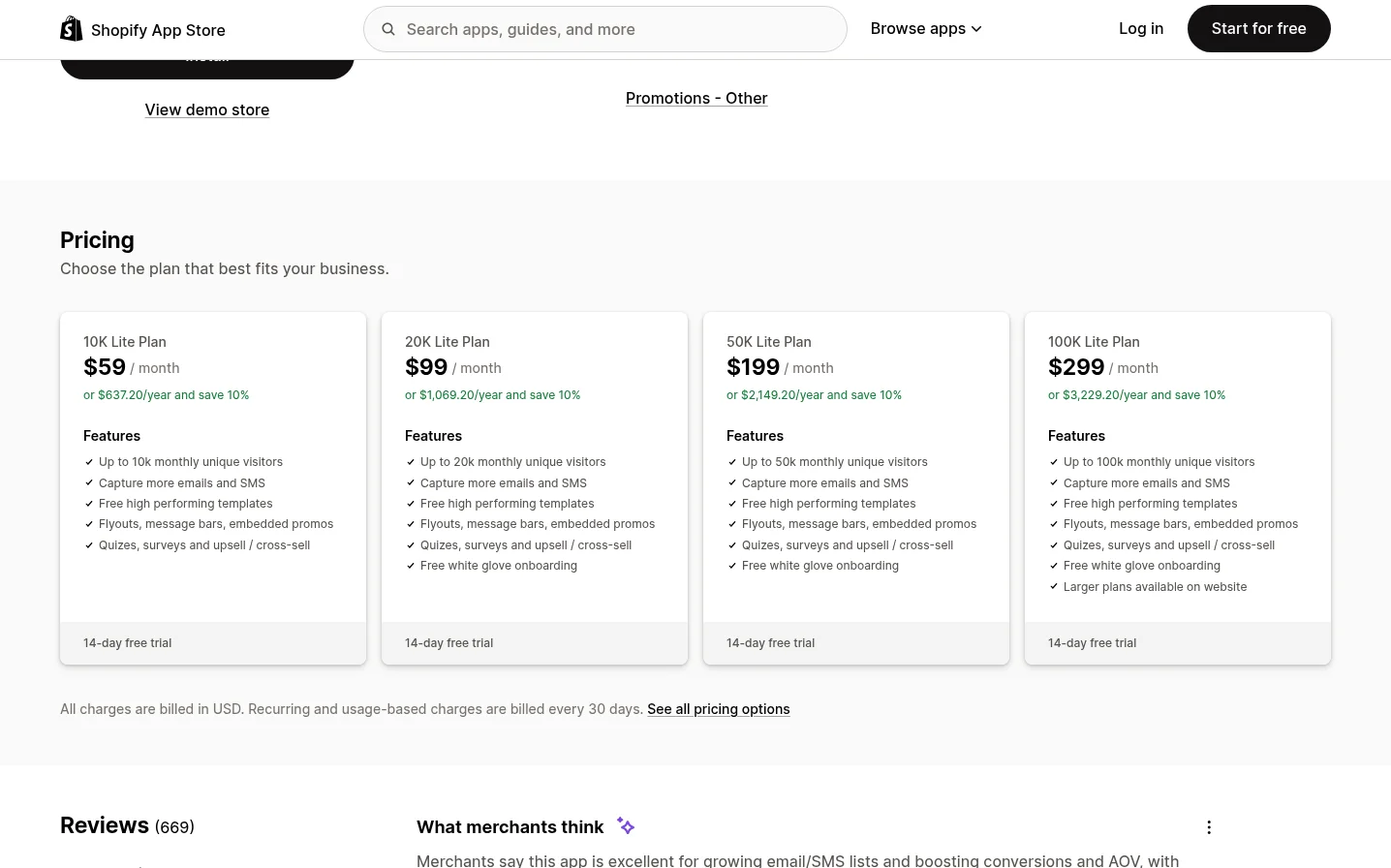
Pricing (as of October 2026): Lite plans start at $59 a month for up to 10,000 monthly unique visitors, then $99 (20,000), $199 (50,000) and $299 (100,000), with 10% off annual billing and a 14-day free trial. See Justuno pricing.
What we liked
- AI Smart Timing and A/B testing help you get more from the same traffic.
- Spotlight anonymous visitor ID can feed more shoppers into abandonment flows.
- Free white-glove onboarding from the 20,000-visitor plan up.
Where it falls short
- No free plan, and the entry price is high for a new store.
- It’s a lead-capture tool only, so you’ll still pay for an email or SMS platform on top.
Best for: Established brands with steady traffic that want expert help tuning their offers.
6. Wisepops
Best for large brands that want popups, web push and an on-site feed
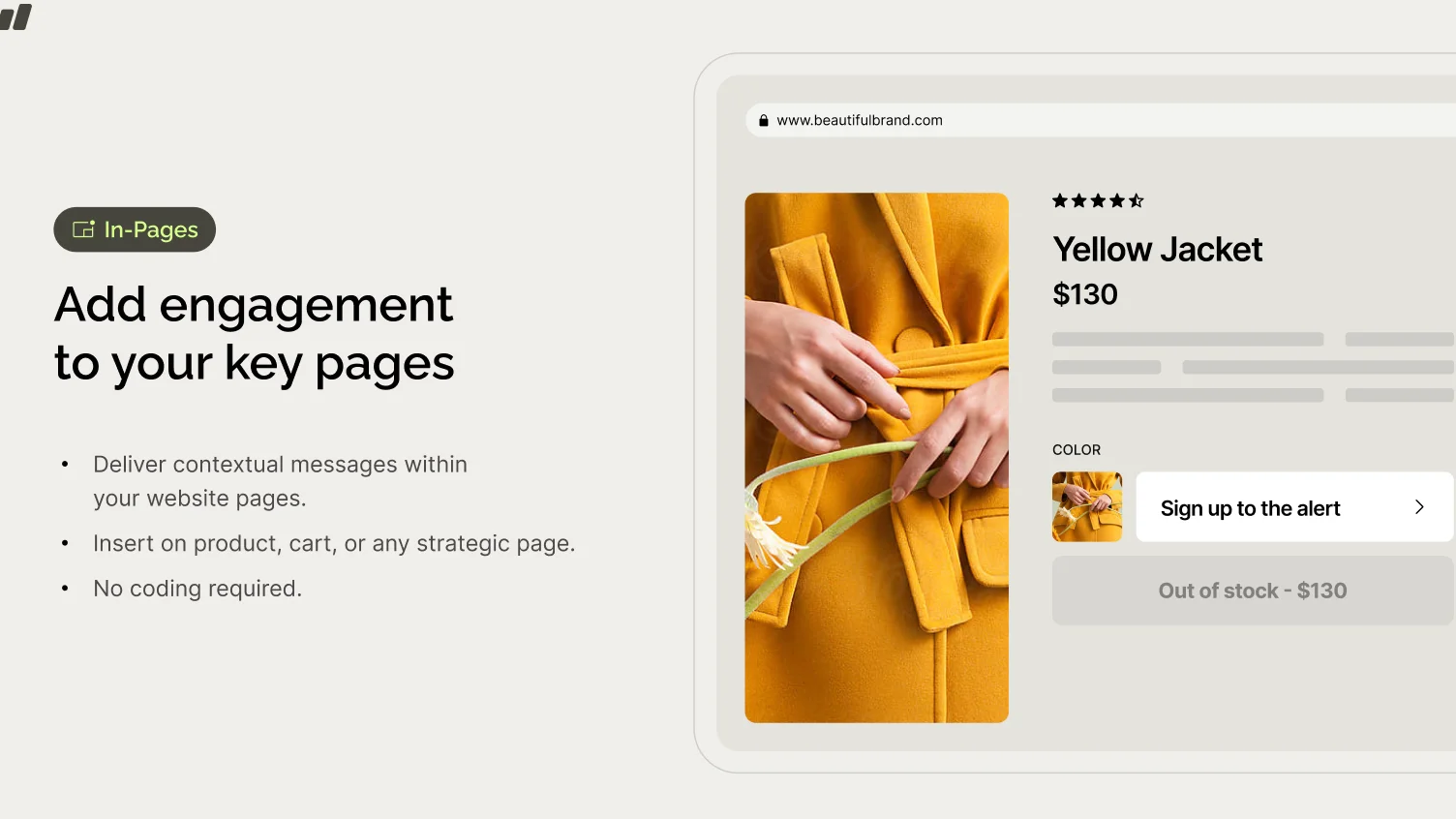
Wisepops covers more on-site formats than most popup apps: popups, embedded widgets, web push notifications and a notification feed that shows a running stream of offers and updates without interrupting the page. It comes with more than 20 ready-made campaigns (cart recovery, upsell, list building) and over 140 templates, AI product recommendations, and A/B testing with control groups, and integrates with Klaviyo, Mailchimp, Omnisend, Drip, Brevo (formerly Sendinblue) and Zapier.
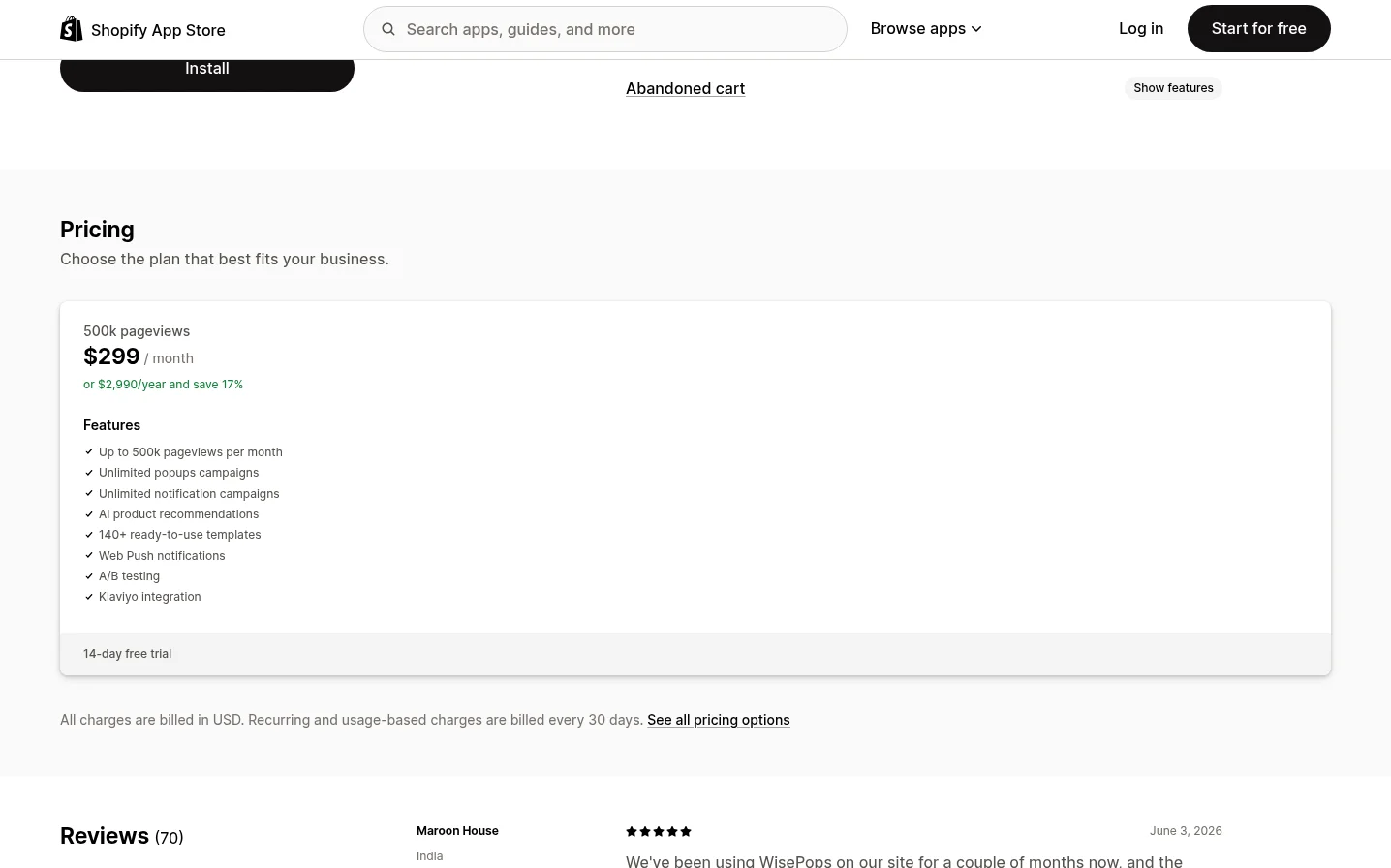
Pricing (as of October 2026): The Shopify App Store listing shows a single plan at $299 a month for up to 500,000 pageviews ($2,990 a year), with a 14-day free trial. Wisepops’ website directs you to book a demo rather than showing public prices. See the Wisepops Shopify listing.
What we liked
- Web push and the notification feed give you ways to reach shoppers that aren’t another popup.
- A/B testing with control groups shows the real lift from a campaign, not just its signups.
- Personalised onboarding and live chat support.
Where it falls short
- At $299 a month it’s priced for large stores, and there’s no smaller plan on the Shopify listing.
- Like the other dedicated popup tools, it needs a separate email platform for follow-ups.
Best for: Large Shopify brands with high traffic and a team that will use every format.
7. Mailmunch
Best for forms and landing pages on a tight budget
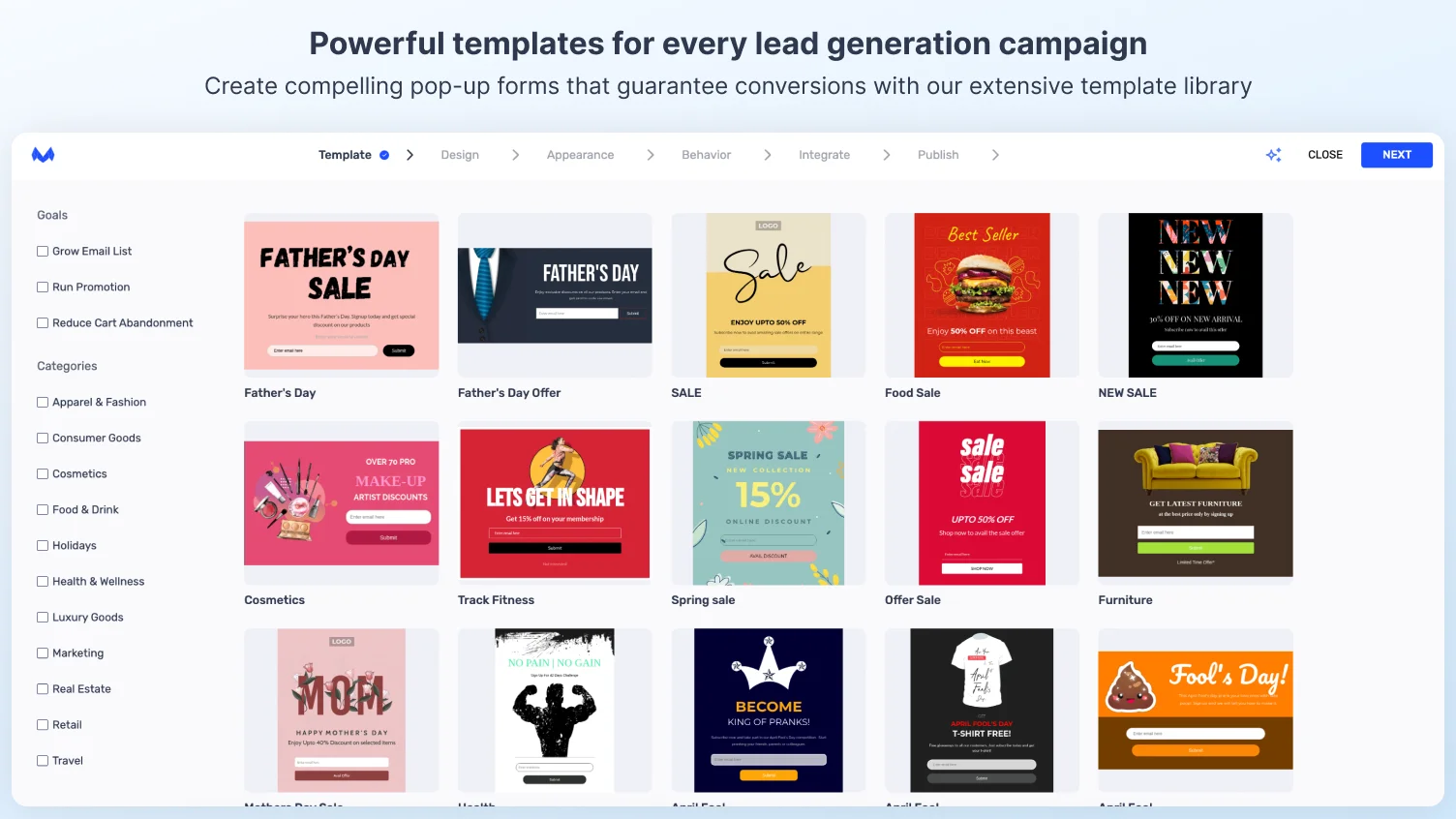
Mailmunch is an email marketing suite built around lead capture. It covers forms and popups, landing pages, newsletters and behaviour-based automations, plus AI tools (an AI chat assistant and QuickCreate) for drafting campaigns quickly. Multivariate split-testing is included. It connects to Mailchimp, Constant Contact, AWeber, Kit (formerly ConvertKit), Keap (formerly Infusionsoft) and Intercom if you’d rather use it only for capture.
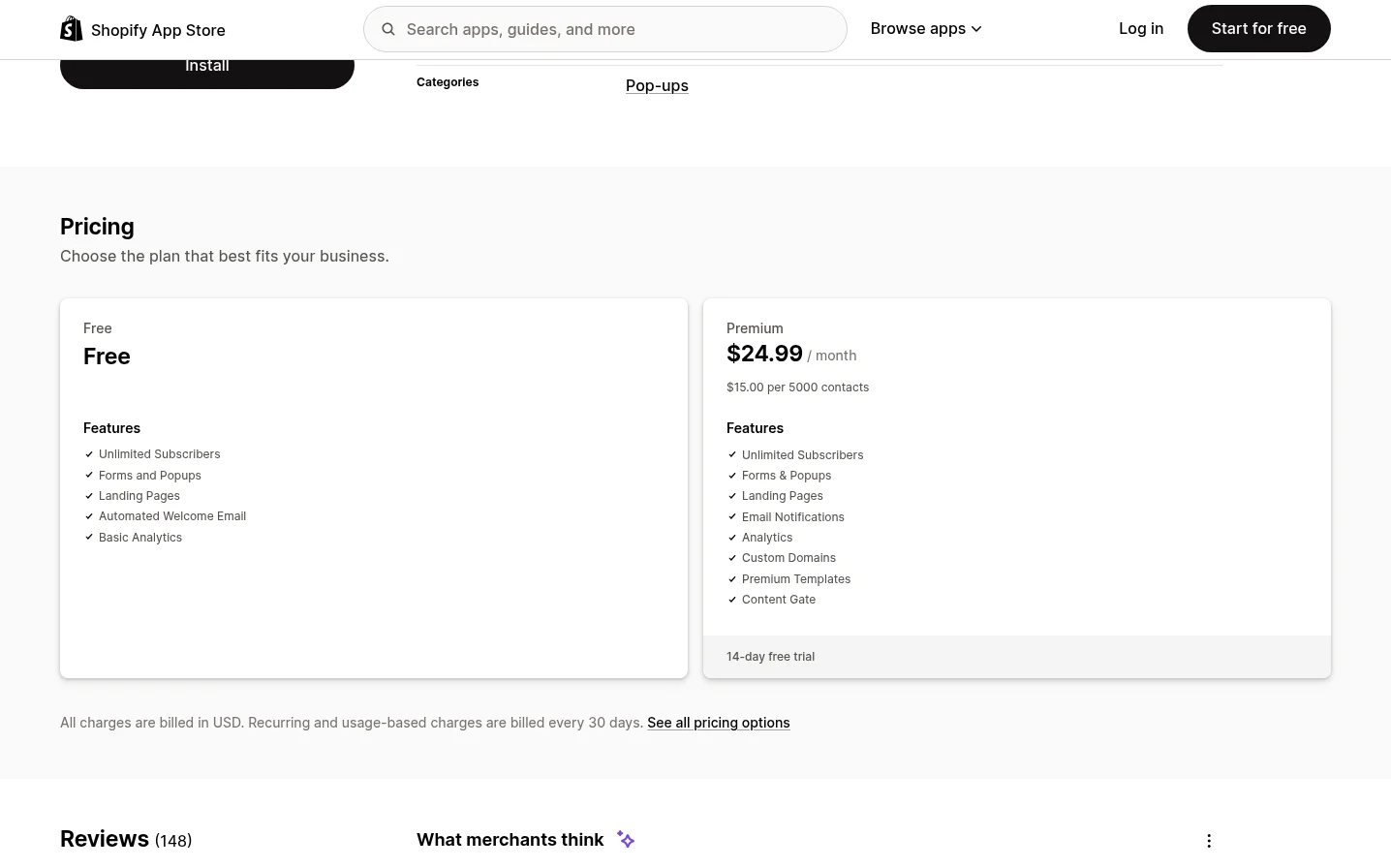
Pricing (as of October 2026): Free with unlimited subscribers, forms and popups, landing pages, an automated welcome email and basic analytics. Premium is $24.99 a month plus $15 per 5,000 contacts, and adds custom domains, premium templates and content gating, with a 14-day free trial. See Mailmunch pricing.
What we liked
- The free plan includes popups, landing pages and a welcome email with unlimited subscribers.
- Landing pages and popups in the same tool help with paid-ad campaigns.
- Split-testing is included.
Where it falls short
- Its Shopify-specific tools are thinner than the dedicated ecommerce apps on this list.
- Premium costs rise by $15 for every 5,000 contacts, which adds up as the list grows.
Best for: Stores that want free popups and landing pages and only need a simple welcome email to start.
8. Pixelpop
Best for simple popups at the lowest price
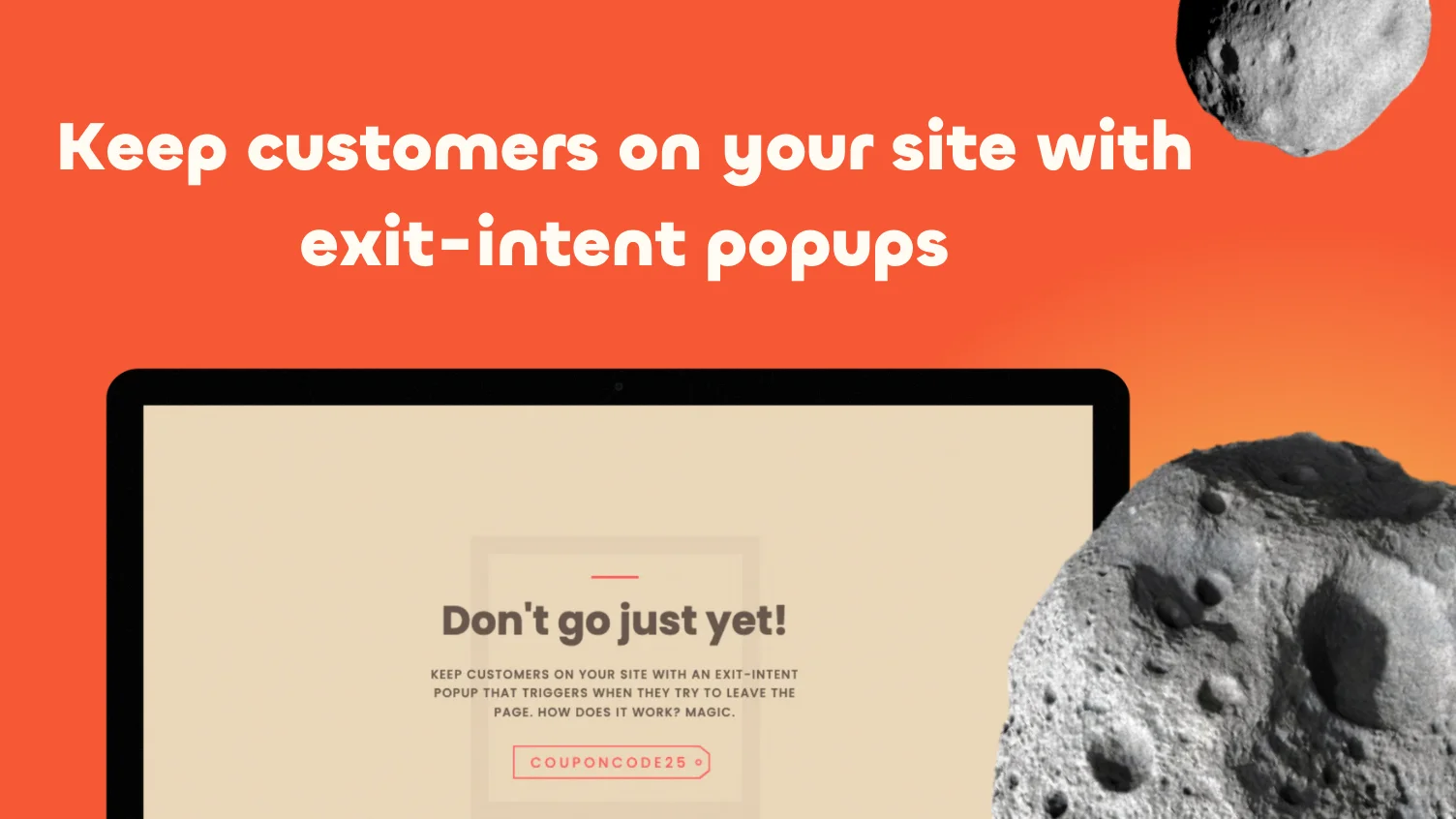
Pixelpop has been on the Shopify App Store since 2016 and keeps things simple. It offers seven popup types (including email signup, announcement and coupon code) in four shapes: promo bar, corner card, modal and full-screen takeover. You choose from six design styles, set colours, fonts and images, and add exit-intent or time delays, targeting and frequency controls. It connects to Mailchimp and Constant Contact.
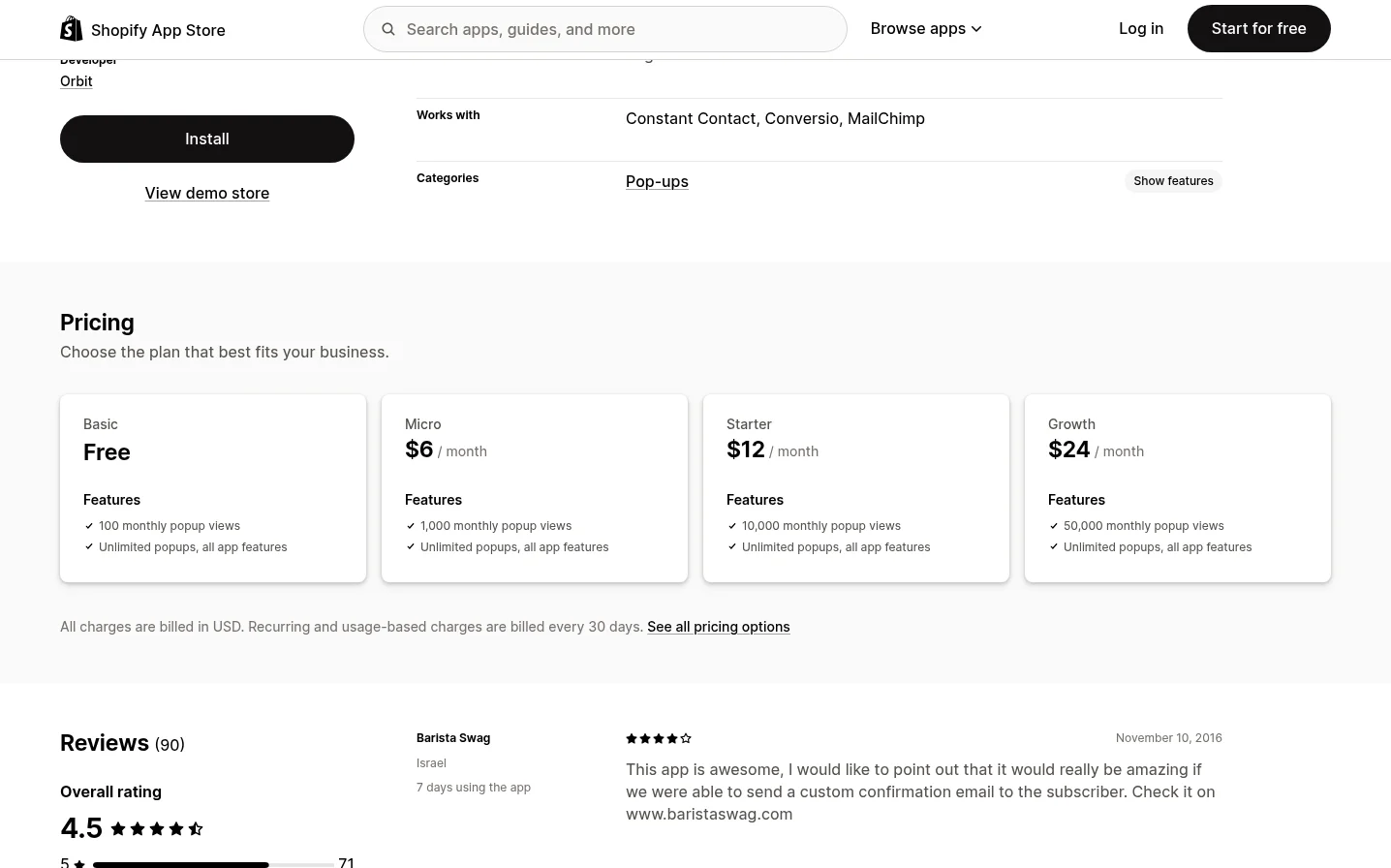
Pricing (as of October 2026): Free for 100 popup views a month. Micro is $6 a month (1,000 views), Starter is $12 a month (10,000 views) and Growth is $24 a month (50,000 views). Every plan includes unlimited popups and all features. See the Pixelpop Shopify listing.
What we liked
- The cheapest paid plans on this list, with all features on every tier.
- Very quick to set up, with no coding.
- Four popup shapes cover bars, corner cards and full-screen takeovers.
Where it falls short
- Its listing doesn’t mention A/B testing, gamified popups or multi-step forms.
- Only a couple of email integrations, so check it works with your email tool first.
Best for: New stores that want one or two clean signup popups for a few dollars a month.
9. NavonaAI
NavonaAI watches how shoppers behave on your store. When someone with items in their cart looks like they’re about to leave, it shows them a one-time discount that is applied to their cart automatically. The offer disappears when they leave, and the same shopper won’t see it twice. It doesn’t ask for their email or phone number. If you are looking to resolving abandoned cart issues, NavonaAI is the best Shopify abandoned cart app for that purpose.
Pricing: Starts at $39 a month, with a 14-day free trial.
What we liked
- Works while the shopper is still on your site, so there’s no email or phone number to collect
- You choose the discount size, minimum cart value, and which products to exclude
- Built-in A/B testing and reports show how much revenue it added
Where it falls short
- Shopify-only, so it isn’t available for stores using other ecommerce platforms
- Focused on cart abandonment prevention, so it doesn’t have email, SMS, or customer engagement features
Best for: Shopify stores that want to catch shoppers before they leave, not only email them afterwards.
How we chose the top popup apps on Shopify
We started from every app in the earlier version of this post and the popup apps Shopify merchants ask us about most. We kept only apps that are currently available on the Shopify App Store and whose main job is capturing email or SMS signups. Then we compared each one on the same points, following our editorial policy:
- Follow-up after signup: whether the app sends email itself or how it syncs to your email tool.
- Triggers and targeting: time delay, scroll, exit intent, page rules and frequency caps.
- Mobile experience: mobile-specific layouts and rules.
- Popup types: standard, multi-step, gamified and embedded forms.
- Testing and reporting: A/B testing and whether revenue is reported, not just signups.
- Real cost: price at realistic traffic and list sizes, and what the free plan includes.
- Shopify App Store rating: used as a signal, weighted lower because older apps have more reviews.
All prices and plan limits come from each app’s Shopify App Store listing or the vendor’s own pricing page in October 2026. Emailwish is our product, and we’ve ranked it first. Everything else was judged on the same criteria.
Which one is right for your store?
| If you… | Choose | Why |
|---|---|---|
| Are a new or small store and want popups plus email flows in one app | Emailwish | Signups start done-for-you flows instantly, and reviews and chat are included |
| Already use Klaviyo or another email tool and want the best dedicated builder | OptiMonk | AI-built custom popups, A/B testing and a full-featured free plan |
| Want email and SMS signups in one platform | Privy | Popups, email and SMS on one subscription |
| Want to try many popup formats for free | Poptin | Unlimited popups and a wide range of types on the free plan |
| Have steady traffic and want expert help | Justuno | Smart timing, visitor ID and white-glove onboarding |
| Run a large brand with high traffic | Wisepops | Popups, web push and an on-site feed with controlled A/B tests |
| Need landing pages as well as popups | Mailmunch | Free forms, popups and landing pages |
| Just want one cheap signup popup | Pixelpop | Paid plans from $6 a month |
Selling on WooCommerce too? See our guide to the best popup plugins for WooCommerce.
FAQ
1. What is the best popup app for Shopify?
It depends on what happens after the signup. If you want popups and email automation in one app, Emailwish is our pick, because new subscribers go straight into prebuilt flows. If you already have an email platform and want the most capable stand-alone builder, OptiMonk is the strongest dedicated popup tool on this list. For email and SMS together, Privy is the established choice.
2. Do popups hurt SEO on mobile?
They can if they’re intrusive. Google’s guidance says pages where content isn’t easily accessible to users coming from search, for example because a popup covers the main content right after they land, may not rank as well on mobile. Popups for legal requirements such as cookie consent or age checks, and banners that use a reasonable amount of screen space, are fine. To stay safe, use a delay or scroll trigger, use slide-ins or bottom bars on mobile, and make the close button easy to tap. Our guide to mobile popups and Google’s guidelines covers the details.
3. Are free popup apps any good?
Yes, for getting started. OptiMonk, Poptin, Mailmunch, Pixelpop and Emailwish all have free plans that can run a real signup popup. The limits are usually traffic caps, branding on the popup, or no follow-up emails. Check which one applies before you build your campaigns around it. Our list of the best free popup apps for Shopify goes deeper.
4. What discount should a popup offer?
Start with the smallest offer that still feels worth it for your price point, often a percentage off the first order or free shipping, and test it against an alternative. On high-margin products a percentage works well. On low-priced products, free shipping often feels bigger than a small percentage. Offers don’t have to be discounts at all: early access, a buying guide or a quiz result can work, and they attract subscribers who are less likely to be discount hunters. For more offers to test, see our list of popup discount ideas.
5. How many popups should a Shopify store run?
Usually two or three at most: a signup offer for new visitors, an exit-intent offer on cart or product pages, and perhaps a seasonal promotion. Use frequency caps and hide signup popups from existing subscribers, so the same shopper doesn’t see the same offer every visit.
Top Popup Apps on Shopify: Conclusion
The best popup app is the one that turns a signup into a sale. If you want the shortest path from popup to revenue, choose an app that sends the follow-up emails too. Emailwish does that with done-for-you flows, reviews and chat in the same app, and Privy does it with email and SMS. If you’re committed to another email platform, OptiMonk is the strongest dedicated builder, with Poptin a good value alternative. Justuno and Wisepops suit larger brands with the traffic to justify their prices, and Mailmunch and Pixelpop are sensible low-cost starting points.
Whichever you choose, keep popups light on mobile, test your offer, and judge success by the revenue your new subscribers bring in, not by signup counts alone. Setting one up for the first time? Follow our guide on how to add a popup to Shopify.
Disclosure: Emailwish is our product. We rank it first and explain the trade-offs honestly.
We keep our content up to dateSee latest updates
- – Full rewrite: removed 4 delisted or non-popup apps, added OptiMonk, Justuno, Poptin and Wisepops, dated pricing, buying guide, decision table, FAQ.
- – Published


Written and fact-checked under our editorial policy. About Emailwish.